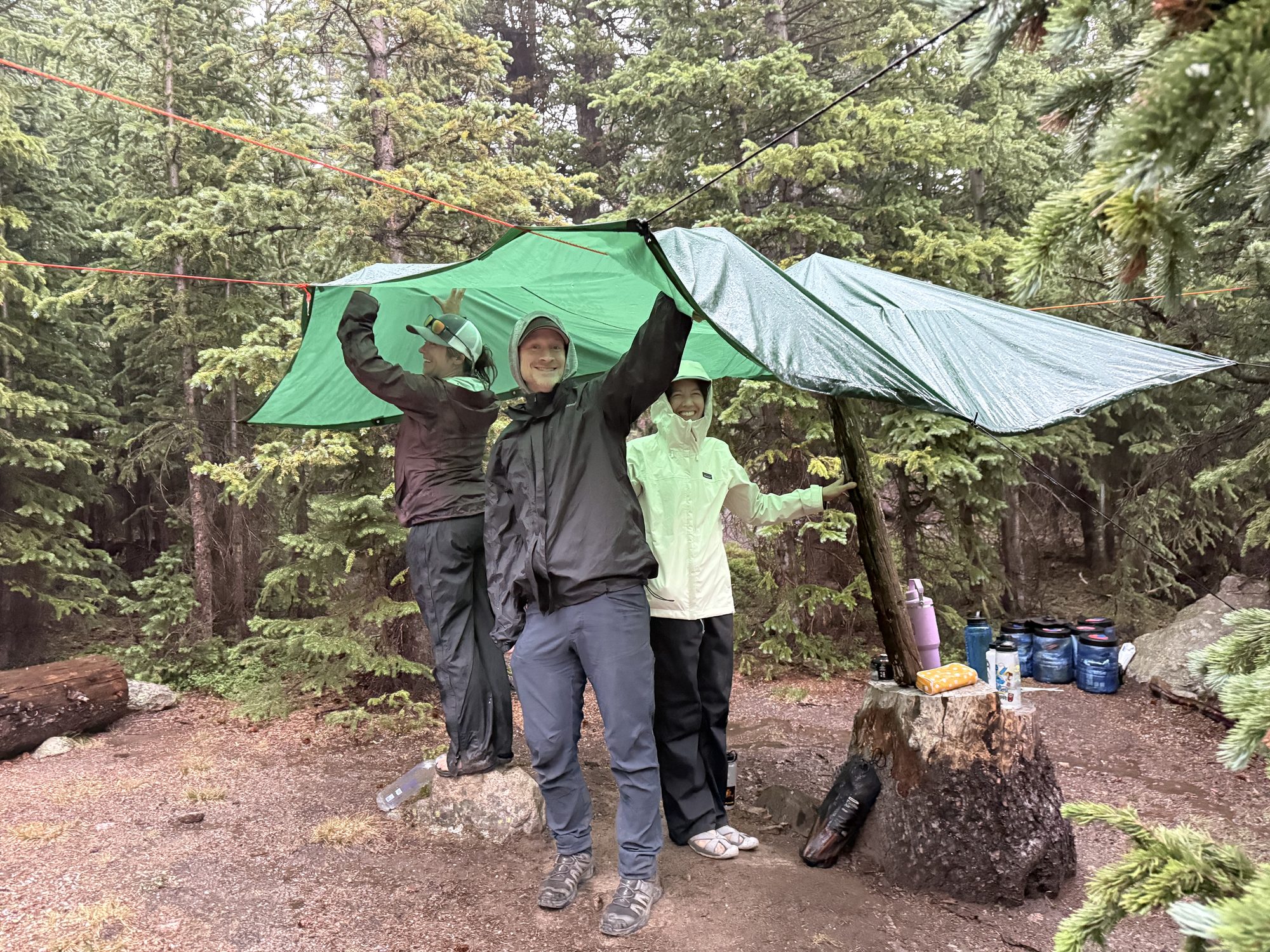
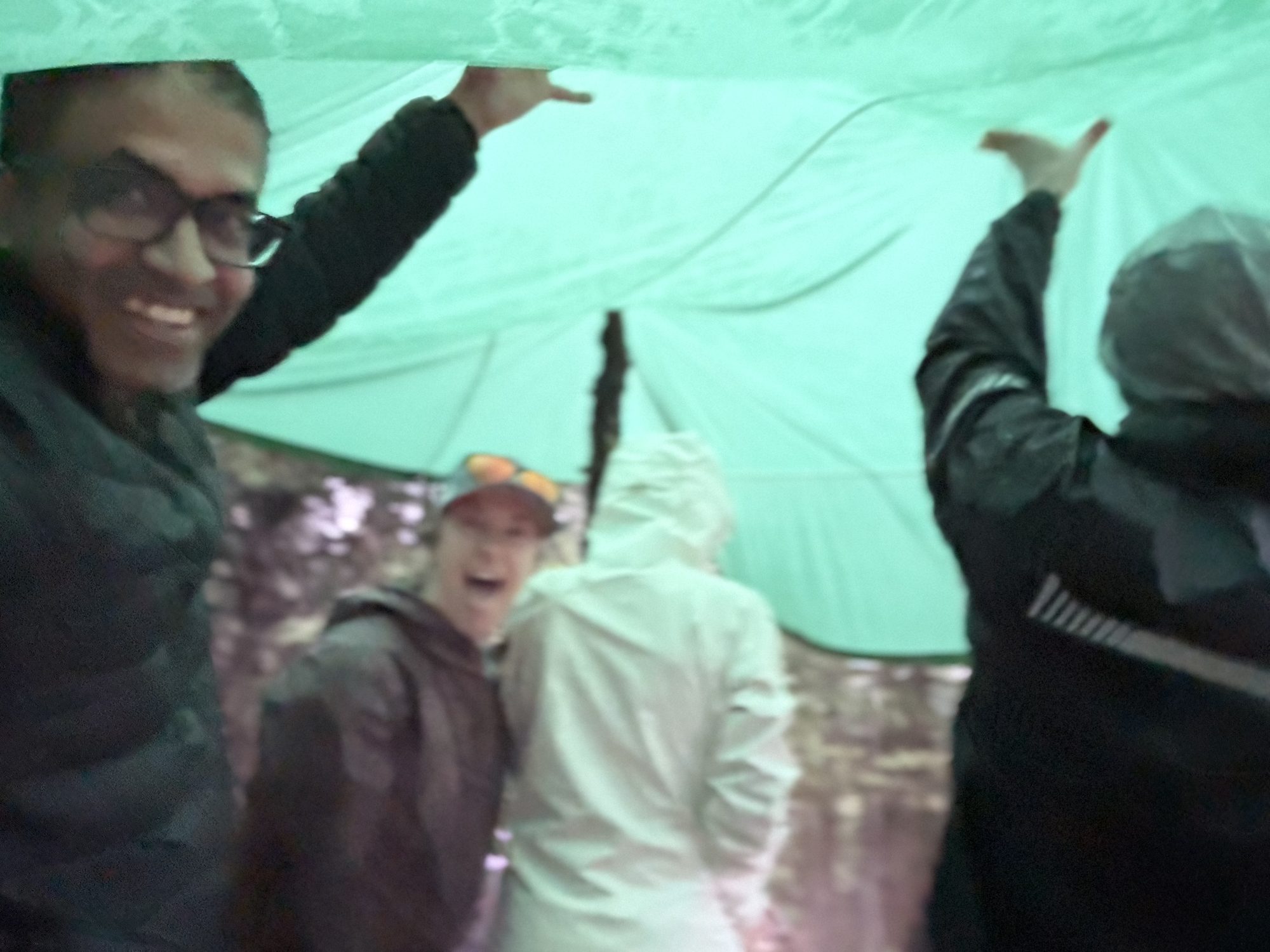
There is a moment, about an hour into a hailstorm at 11,000 feet, when you stop being a person on vacation and become something simpler: four sets of hands holding a green tarp up so the water has somewhere to go.
We were laughing. That's the part I keep coming back to. Marble-sized hail was coming down hard enough that it hurt where it hit our fingers, the temperature had fallen off a cliff, everything we owned was wet, and the four of us (Traci, Scott, Melissa, and me) were standing under a sagging green rectangle pushing water off it every ninety seconds and laughing like this was the best thing that had happened all week.
It might have been.
But I'm getting ahead of myself.
Before: Estes Park, and a Robot With My Pizza
I flew into Colorado on July 19th, a day ahead of the trip, and checked into Murphy's Resort in Estes Park. The first thing I did after dropping my bags was go find lunch, because I have learned that the last real meal before a backpacking trip deserves a little ceremony.
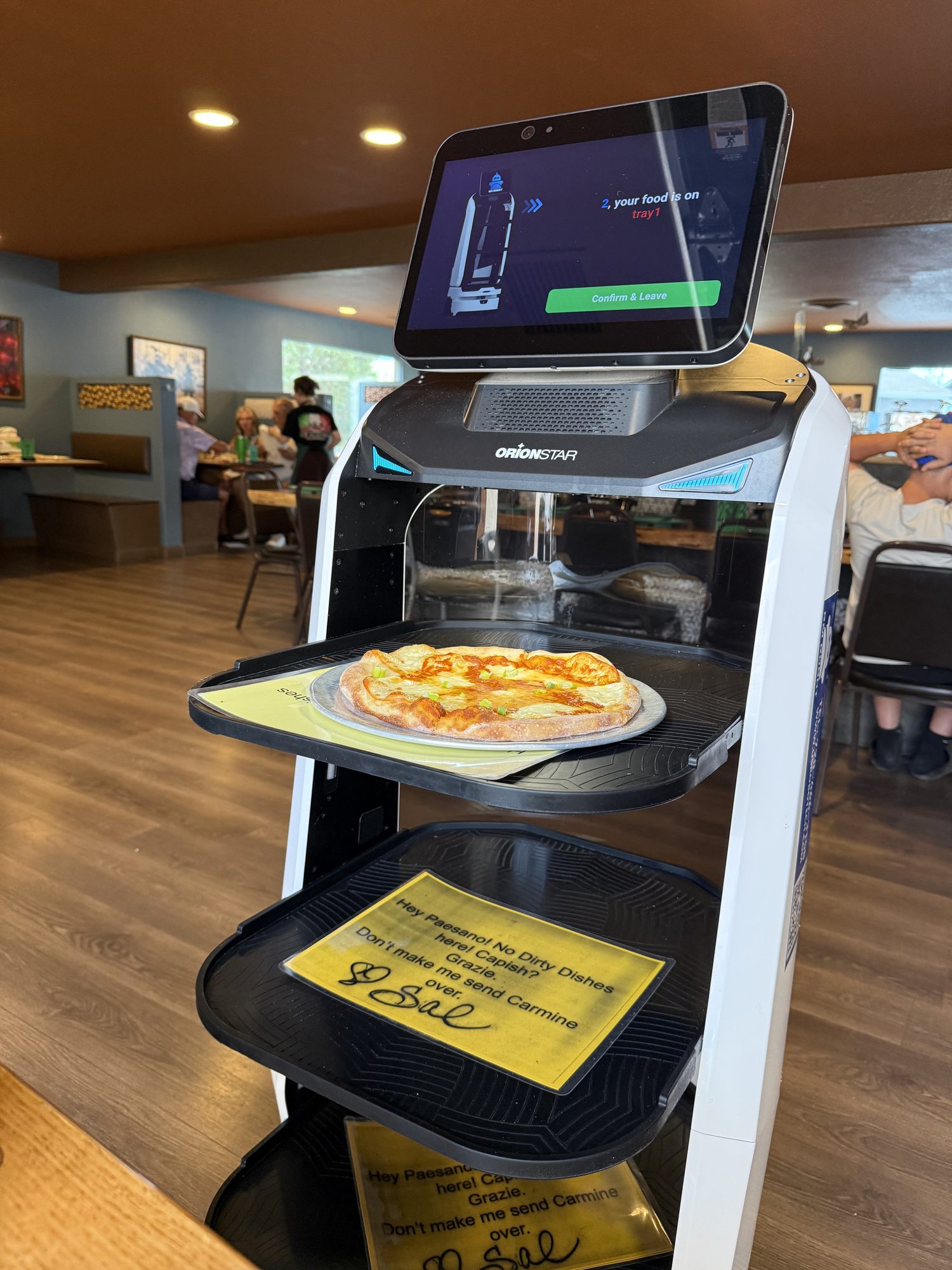
I ended up at Antonio's New York Pizza. I ordered pizza and garlic knots, and a robot brought them to my table.
I want to be clear about how much this delighted me. I work in technology. I have opinions about automation and its trajectory and all the serious things one is supposed to have opinions about. And none of that mattered at all in the moment. A small wheeled machine rolled up with my garlic knots and I was as pleased as a kid at a science museum. There is something clarifying about being genuinely, uncomplicatedly amazed by a thing. It doesn't happen as often as it used to.
Afterward I walked along Estes Lake, killing the afternoon, letting the altitude start its slow work on my lungs. Estes Park sits at about 7,500 feet. My body was still operating on sea-level assumptions and East Coast time, both of which the next five days would systematically dismantle.
At five o'clock I walked into the Estes Park Mountain Shop for the group meeting, and met the people I'd be spending the week with.
Traci Salisbury, our guide, from Salt Lake City. Scott, from Minnesota. Melissa, from Connecticut. Debbie and Tyler, from Tampa. Five of us total, plus Traci.
We collected gear: packs, sleeping systems, the whole kit. Bear canisters and food would come the next morning, on the day we actually walked. And here I made my first real decision of the trip, which was to abandon my own backpack.
I'd brought my Osprey Exos 58. I love that pack. I had every intention of carrying it. But looking at the bear canister we'd each be hauling, and looking at the Exos, I did the mental geometry and didn't like the answer. The canister was going to dominate that pack in a way that would make everything else an afterthought. So I took the outfitter's pack instead.
I mention this because it's the kind of small, unglamorous decision that shapes a trip more than the dramatic ones. It's also, as it turns out, the decision I'd think about again on Day 1 while my neck ached.
Day 1: Into the Woods
Lower Lawn Lake Trailhead to Golden Banner. 3.5 miles, about 1,100 feet of gain.
Floyd, our driver, and Traci picked me up at Murphy's at eight, then collected everyone else from their hotels. We ate breakfast at the trailhead, packed our canisters with snacks and group gear (the water filtering kit, the tarp, the shared burden of a group in the backcountry), and then we walked.
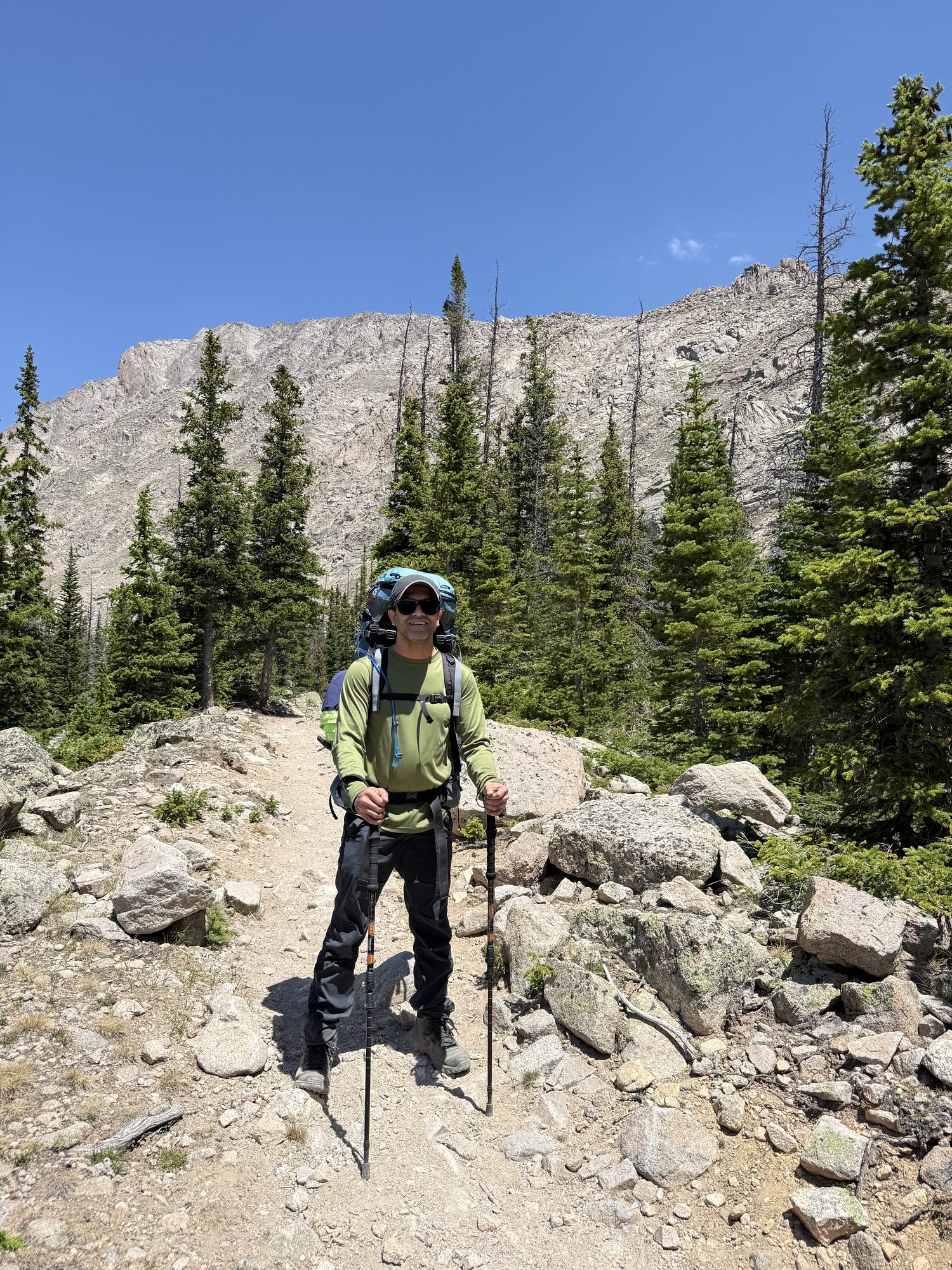
I'll be honest: the hike itself wasn't much to look at. Woods, mostly. Trail through trees with no views to speak of. It was hot and it was sweaty, even under shade, and my pack felt heavy in that particular way a first-day pack always feels heavy. Not unbearable, just constantly present, a fact you can't put down. Loaded with the canister, group gear, water and five days of everything else, I'd guess it ran 40 to 45 pounds.
It rained partway through and I had to dig for my rain jacket, which is a small indignity every backpacker knows: the item you need is always at the bottom, always, no matter how carefully you packed.
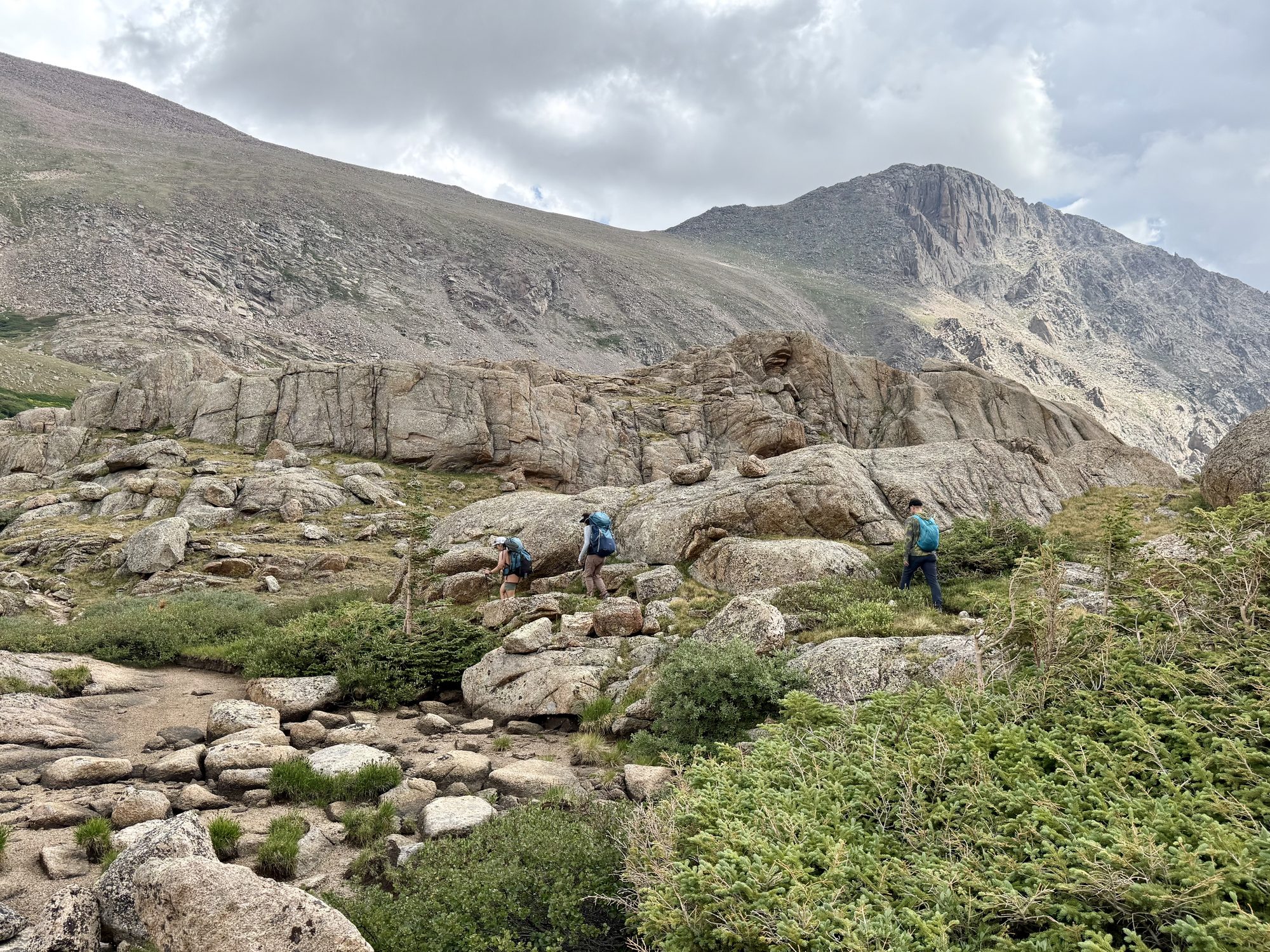
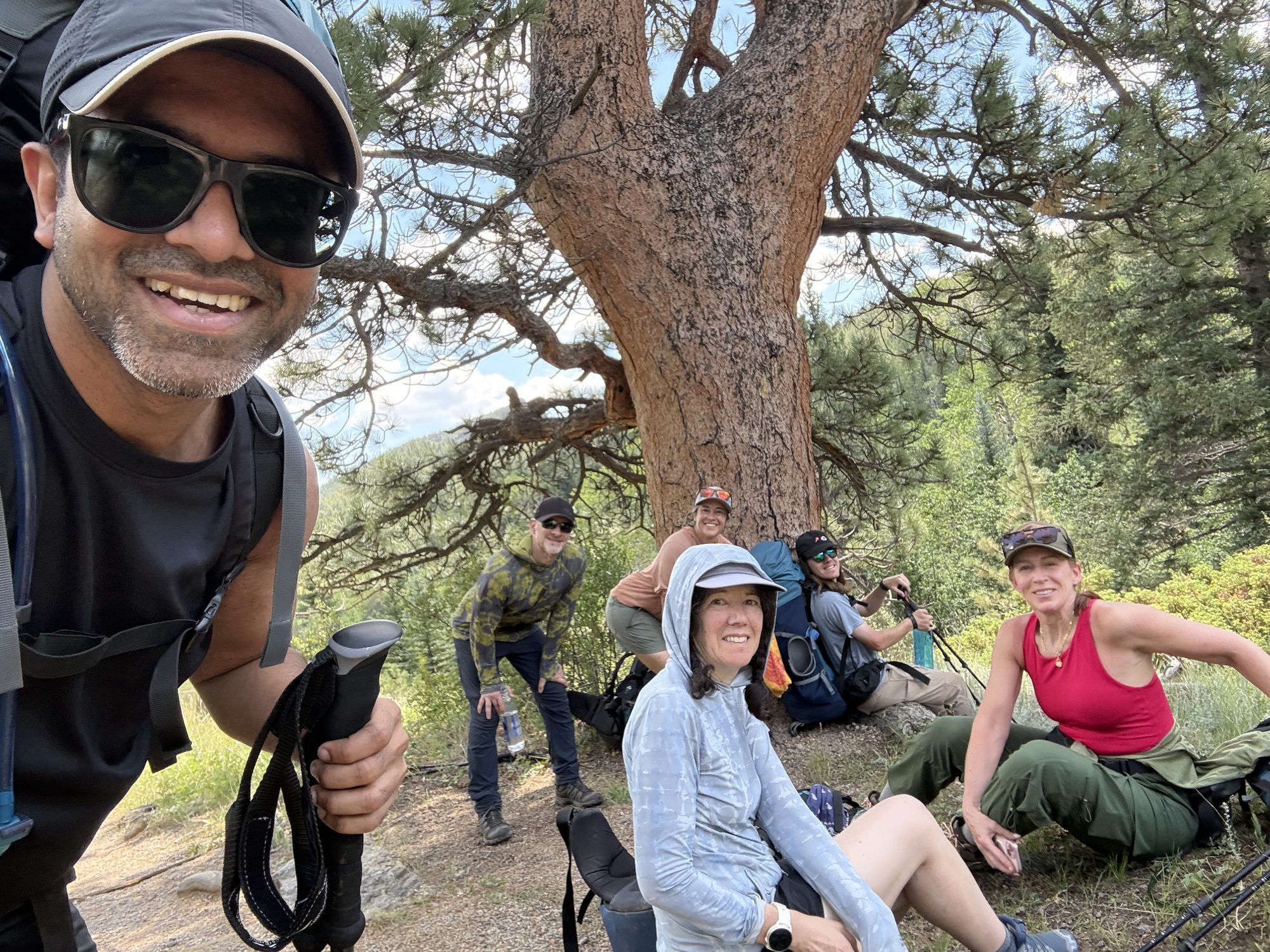
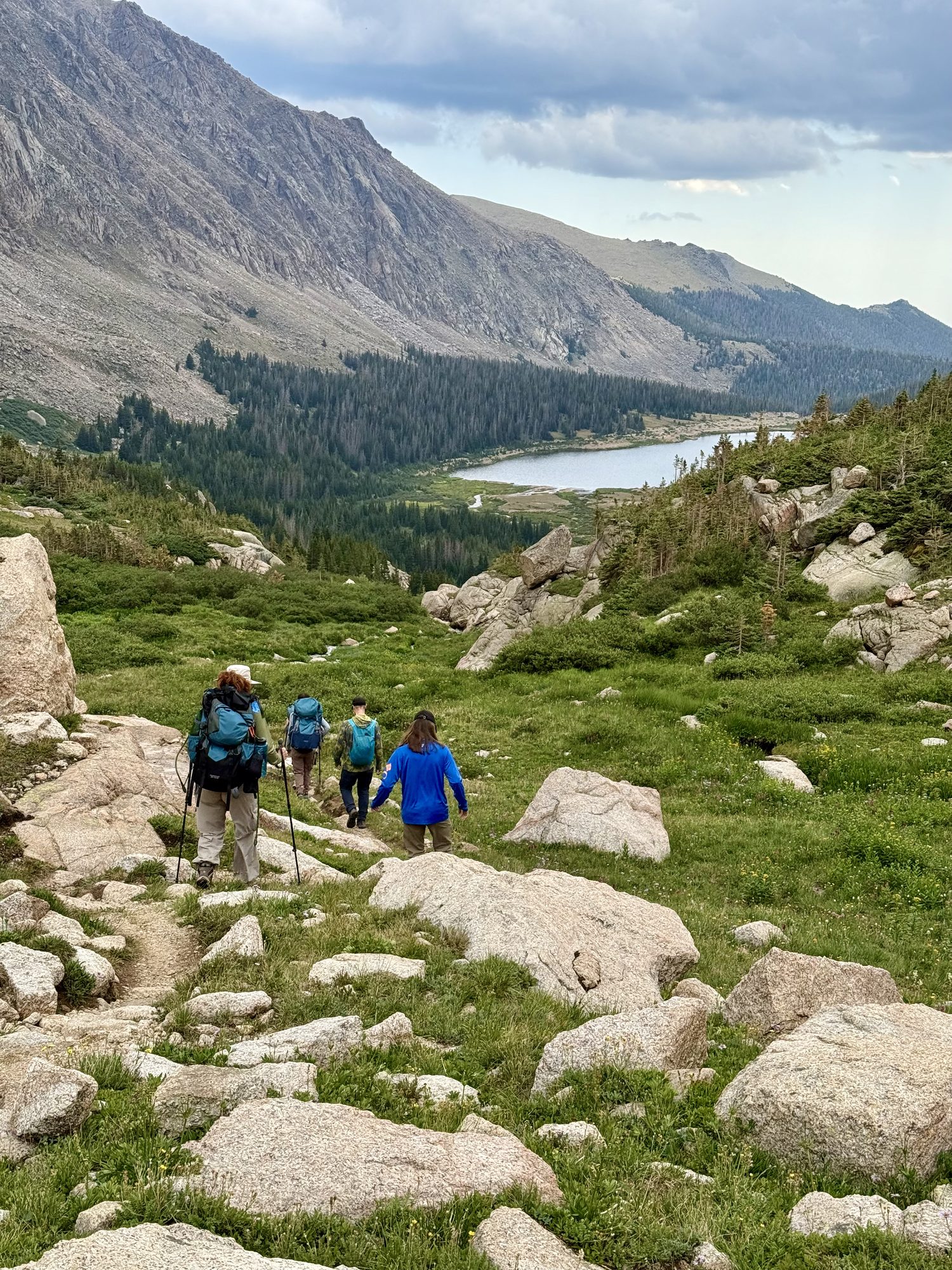
But I took photographs. That's what I do. The group hiking under their loads, people resting with their packs propped against trees. Not scenic landscape work, just the texture of a day. Some of my favorite photos from the whole week came from that unremarkable stretch of woods.
We had our packed lunch along the Roaring River. Traci went ahead to check which of the two campsites was available, since they're first come, first served and she didn't want to march five people with full packs up to a site only to find it taken. That's the sort of thing you don't notice a good guide doing until you think about it later.
Golden Banner
We got the site. The Roaring River ran close enough that it was our water source, and after we'd hauled the canisters to the kitchen area, Traci had us set up the rain tarp as a team-building exercise. Five strangers, one tarp, a lot of opinions about guylines. It worked, more or less. It would work considerably less well two days later, but we didn't know that yet.
Then I asked if anyone wanted to take a dip in the river.
I should clarify something here, because this becomes a running theme and I don't want to give the wrong impression. I am not a cold water person. I don't take cold showers. I have never voluntarily plunged into anything at home. But something changes after a full day of climbing in the heat with forty-odd pounds on your back. Cold water stops being an ordeal and becomes the obvious answer to a question your entire body is asking.
Everyone came down. Everyone put their feet in. Nobody else went all the way under.
I did. The water was cold, properly cold, snowmelt cold, but tolerable given the heat I'd been carrying around all day. I washed the sweat off and came out feeling like a different person. There's a specific quality to that feeling that I don't have a good word for. Reset, maybe. Like the day started over.
Back at camp, before dinner, I asked the group if anyone had ever had spruce tea. Nobody had. So I cut a few spruce tips and asked Traci if she'd boil them, and we all sat around drinking spruce tea in the woods. Everyone seemed to like it. There's something satisfying about handing people a small piece of the forest they're standing in.
We also had a squirrel. He spent the entire evening working the perimeter of our kitchen area, extremely curious about whatever Traci was cooking, returning again and again with a confidence that bordered on rude. We defended our food. He kept coming. Traci named him the ninja squirrel, and the name stuck for the rest of the trip, eventually becoming a general category. Every campsite had a ninja squirrel, though none matched the one at Golden Banner for sheer commitment.
After dinner we sat and talked until the light went, and when it got dark everyone went to their tents.
The First Data Point
Two things happened that night worth recording.
The first: my neck hurt. Pack weight riding on my shoulders, most likely, and it turned into a mild headache. I asked Traci for Tylenol, took it before bed, and felt fine.
The second: I couldn't sleep past four in the morning. Estes Park is two hours behind my home time zone, and my body was having none of it. So I lay there in the dark for a couple of hours.
In the morning, my Garmin told me I'd had non-restorative sleep and my body battery was in the basement. Later, after the hike, it informed me that my recommended recovery time was fifty-nine hours.
Fifty-nine hours. Two and a half days. For 3.5 miles.
My reaction, roughly: are you out of your mind?
I want to be fair to the watch. I'd been jet-lagged, I'd slept badly, and I'd gone from sea level to 9,000 feet in about thirty hours. On paper the alarm was reasonable. But I felt fine. Not "pushing through it" fine. Actually fine. My legs were good, my energy was good, and the only thing that had bothered me all day was a neck ache that a Tylenol fixed.
So I made a decision that I think was the right one. I stopped believing the watch for the rest of the trip.
I'll come back to this.
Day 2: Everything Opens Up, Then Everything Closes In
Golden Banner to Lawn Lake. 4.5 miles, about 1,500 feet of gain, up to 11,000 feet.
Awake at four again. Stayed in bed until six out of principle. Garmin again reported that I'd slept badly and my body battery was poor, and this time I just closed the app. It was measuring something real, but it wasn't measuring me.
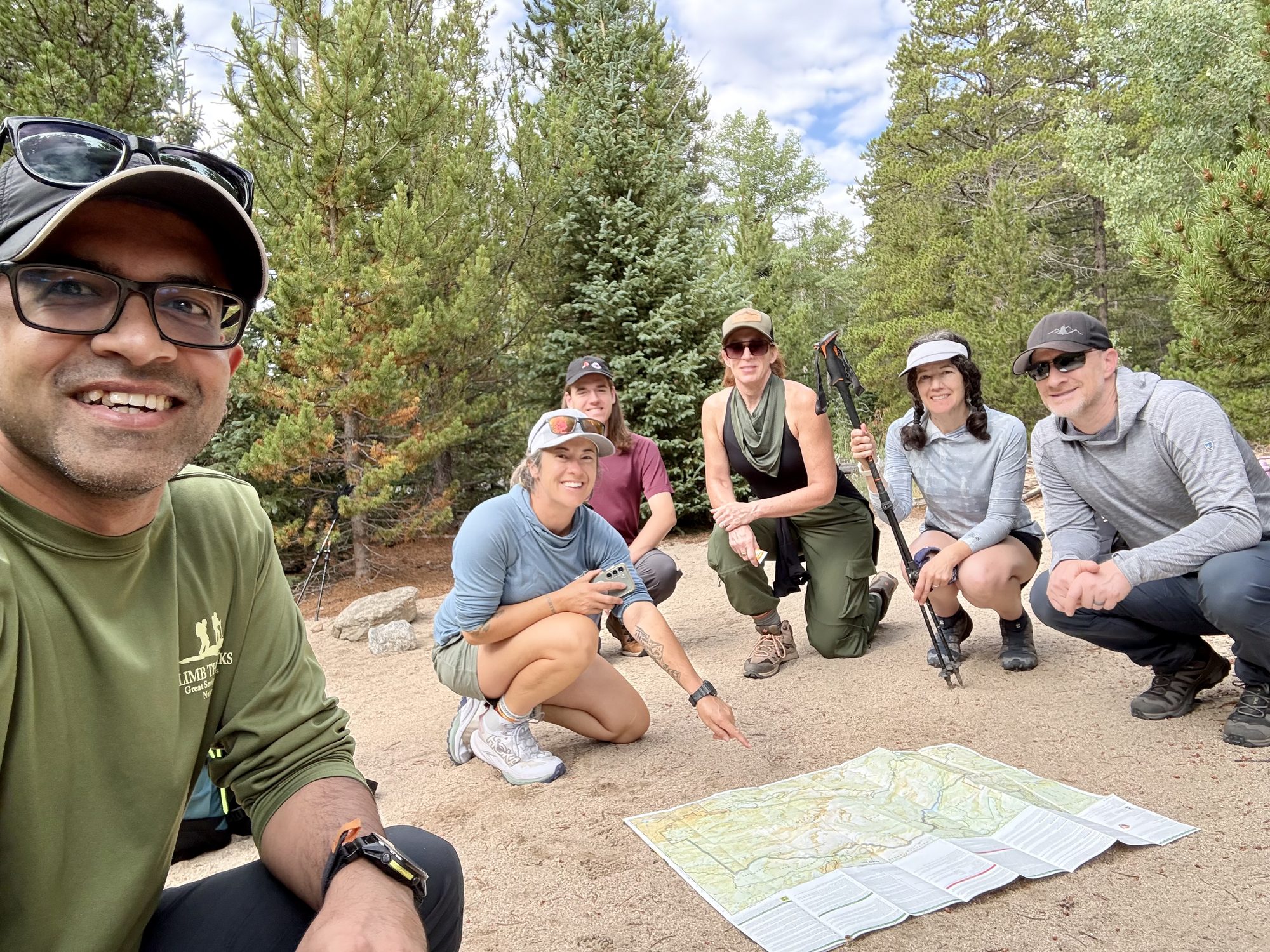
We ate, packed up tent and tarp, and before we left Traci laid the map out on the ground and briefed us: here's where we are, here's where we're going, here's the terrain between. Next stop, Lawn Lake.
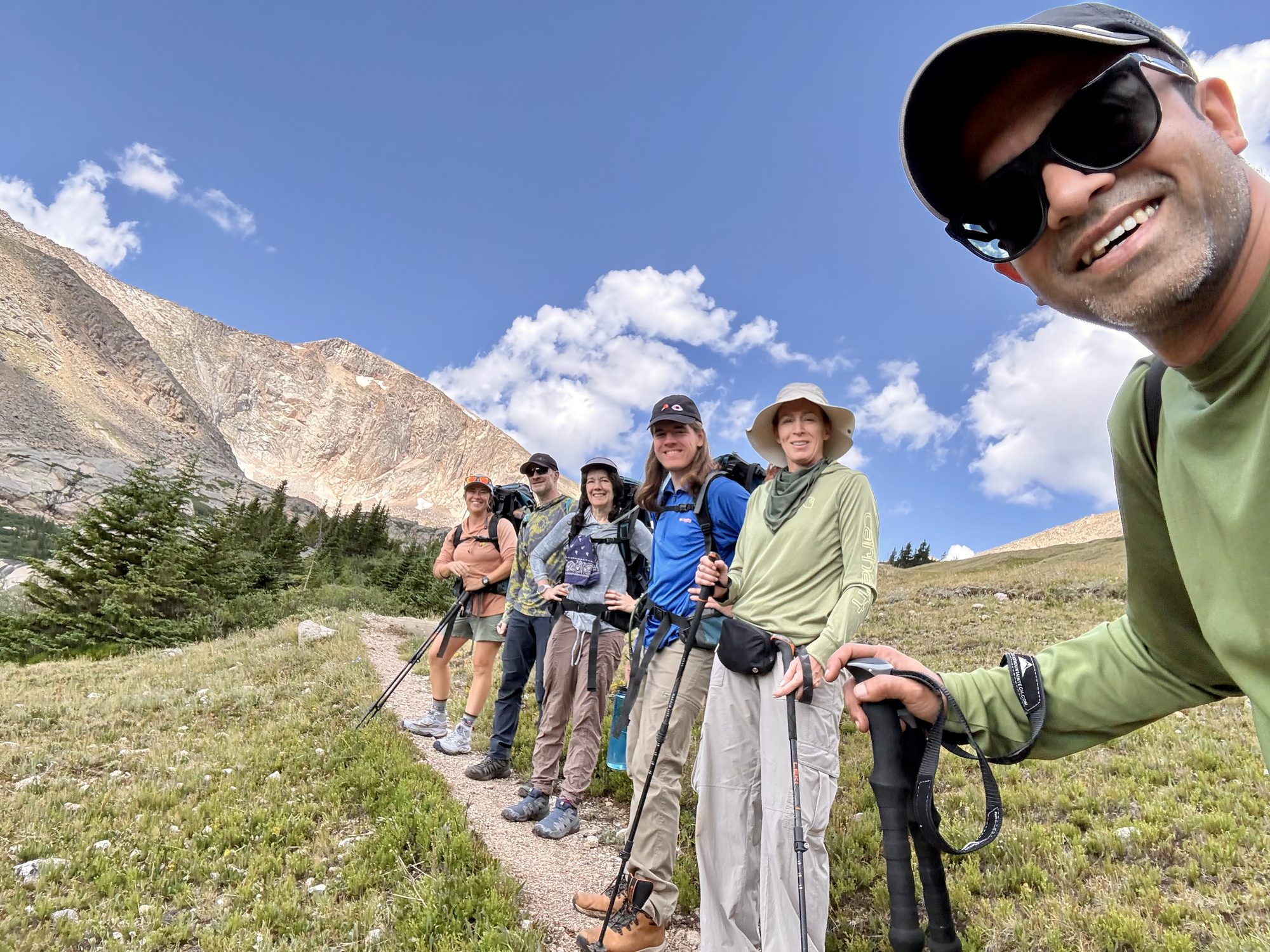
I loved the map spread out on the dirt with everyone leaning over it. It's one of the last genuinely analog rituals left in travel. I got everyone to gather around it and took a group selfie.
The Hike I Came For
This was the day the trip announced itself.
As we climbed, the woods started letting go. Space opened up. Mountains appeared where there had been only trees the day before, and kept appearing, and the whole quality of the walk changed. Day 1 had been a corridor. Day 2 was a room with the roof off.
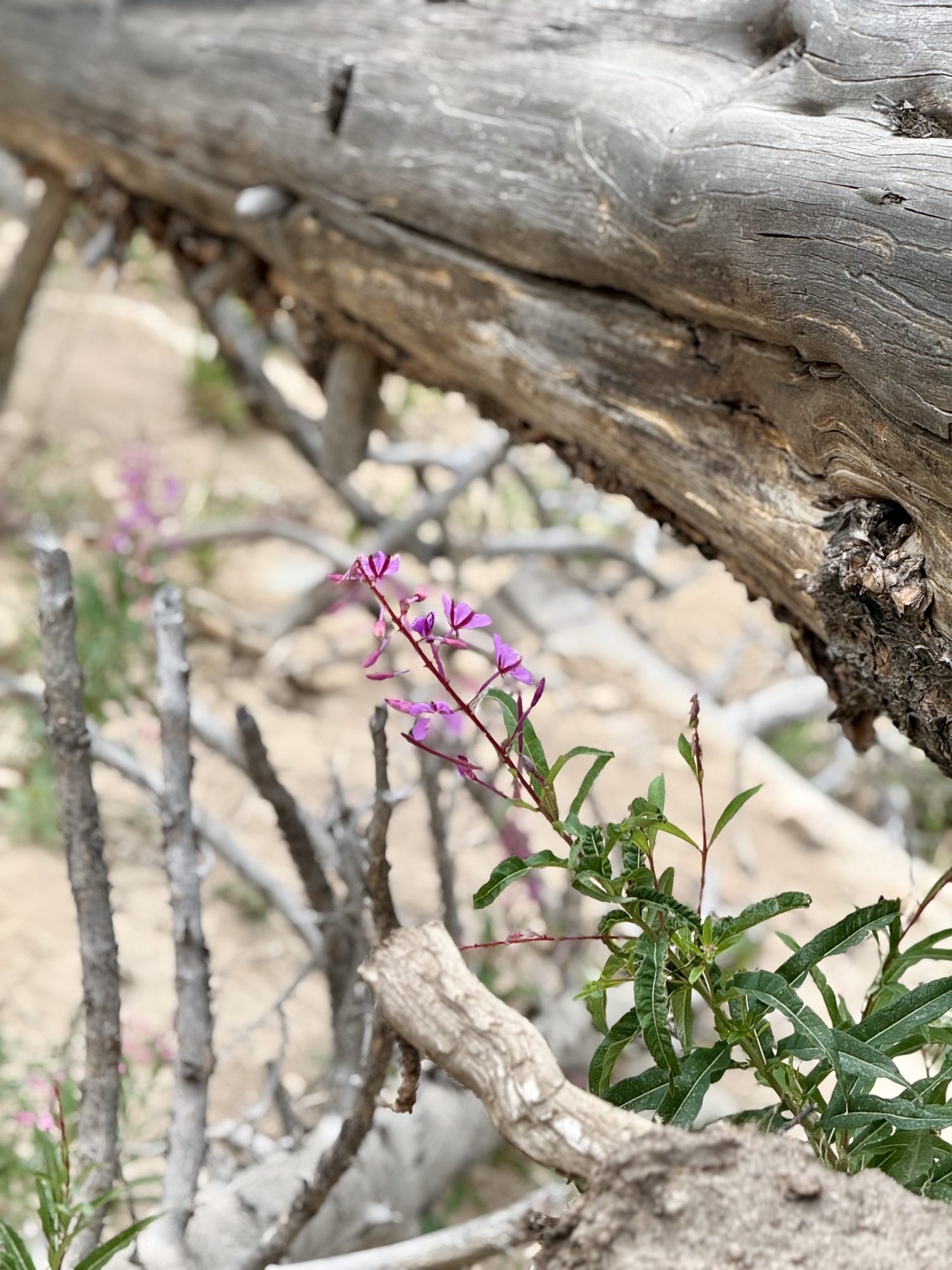
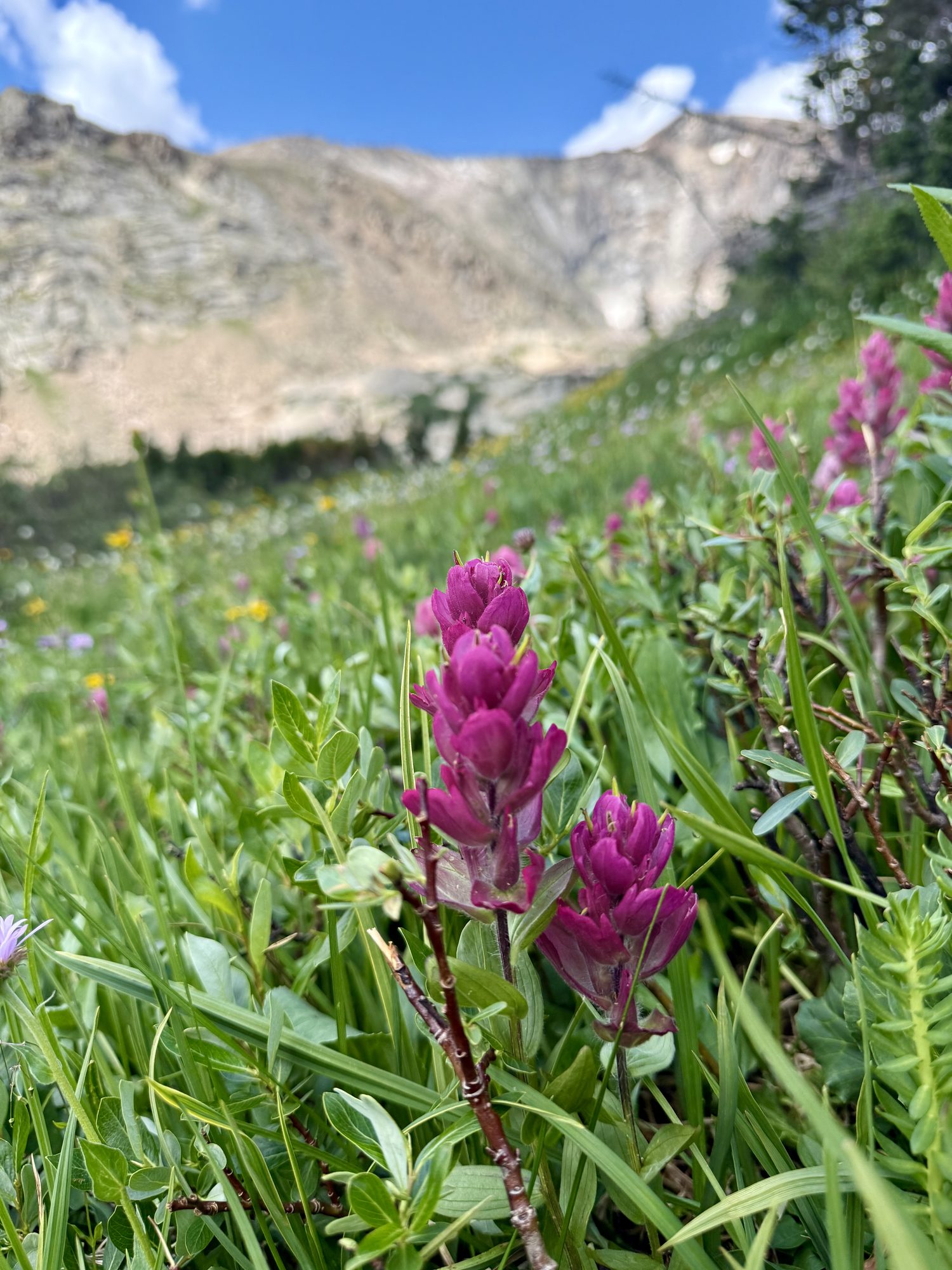
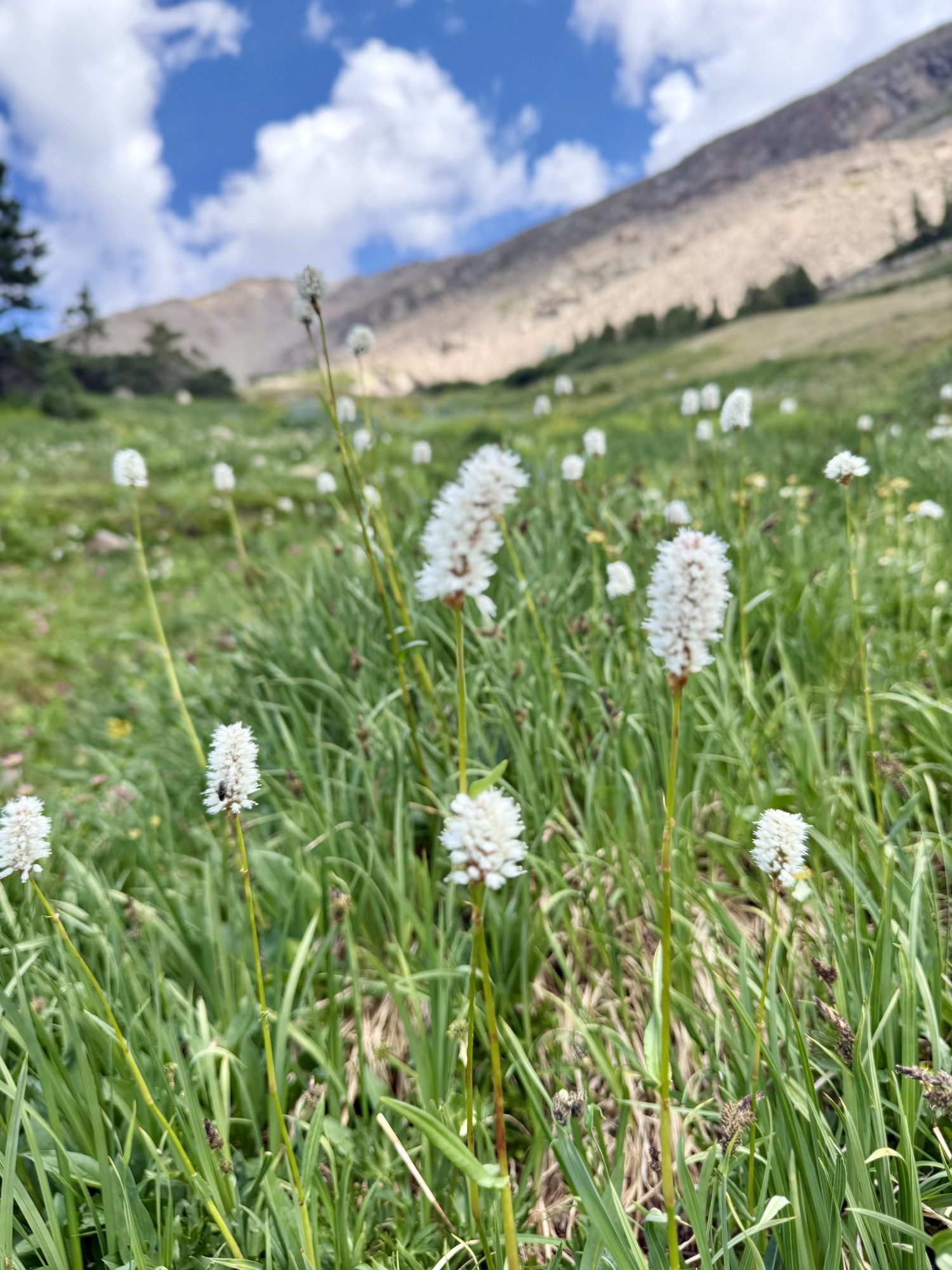
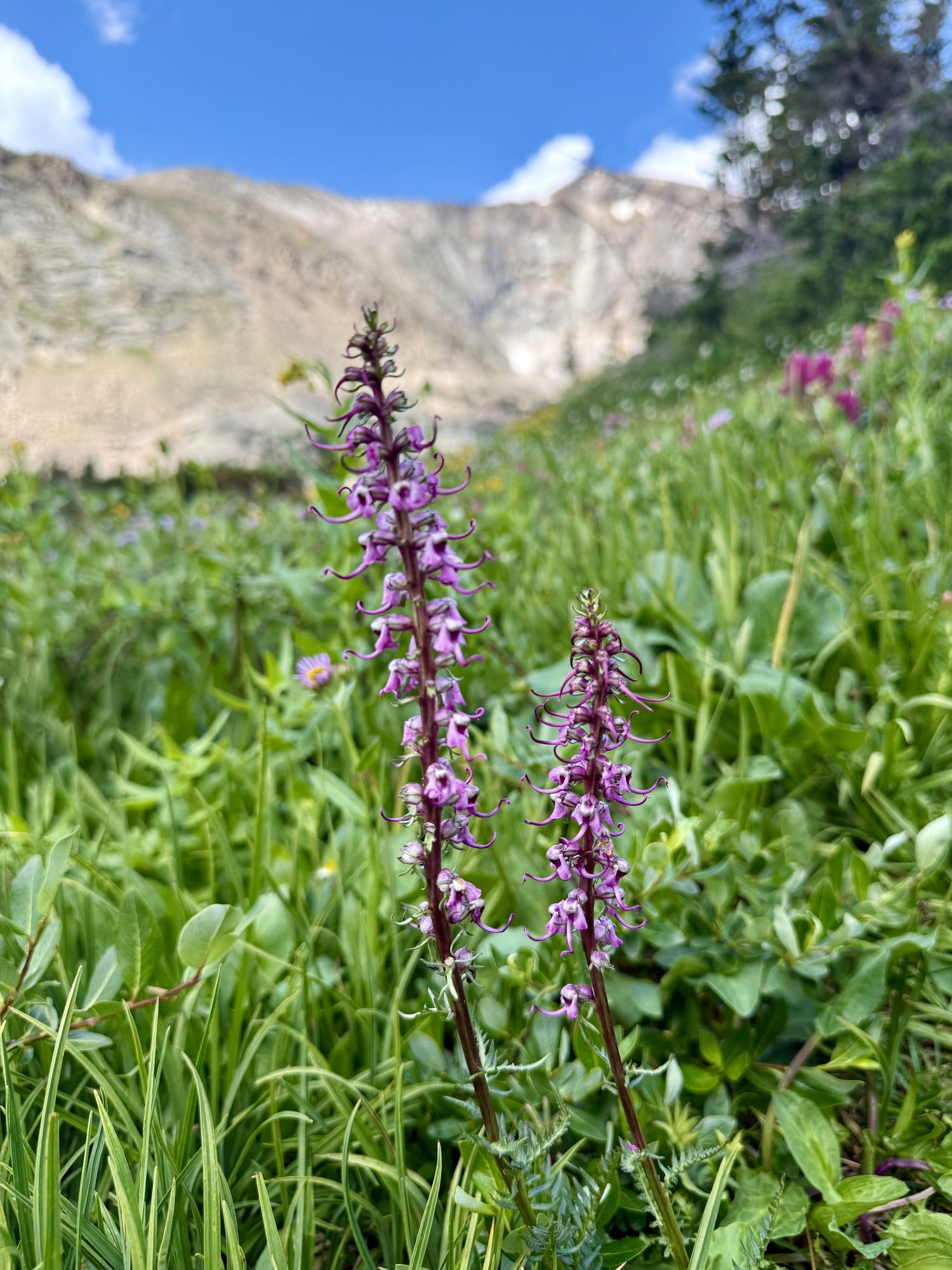
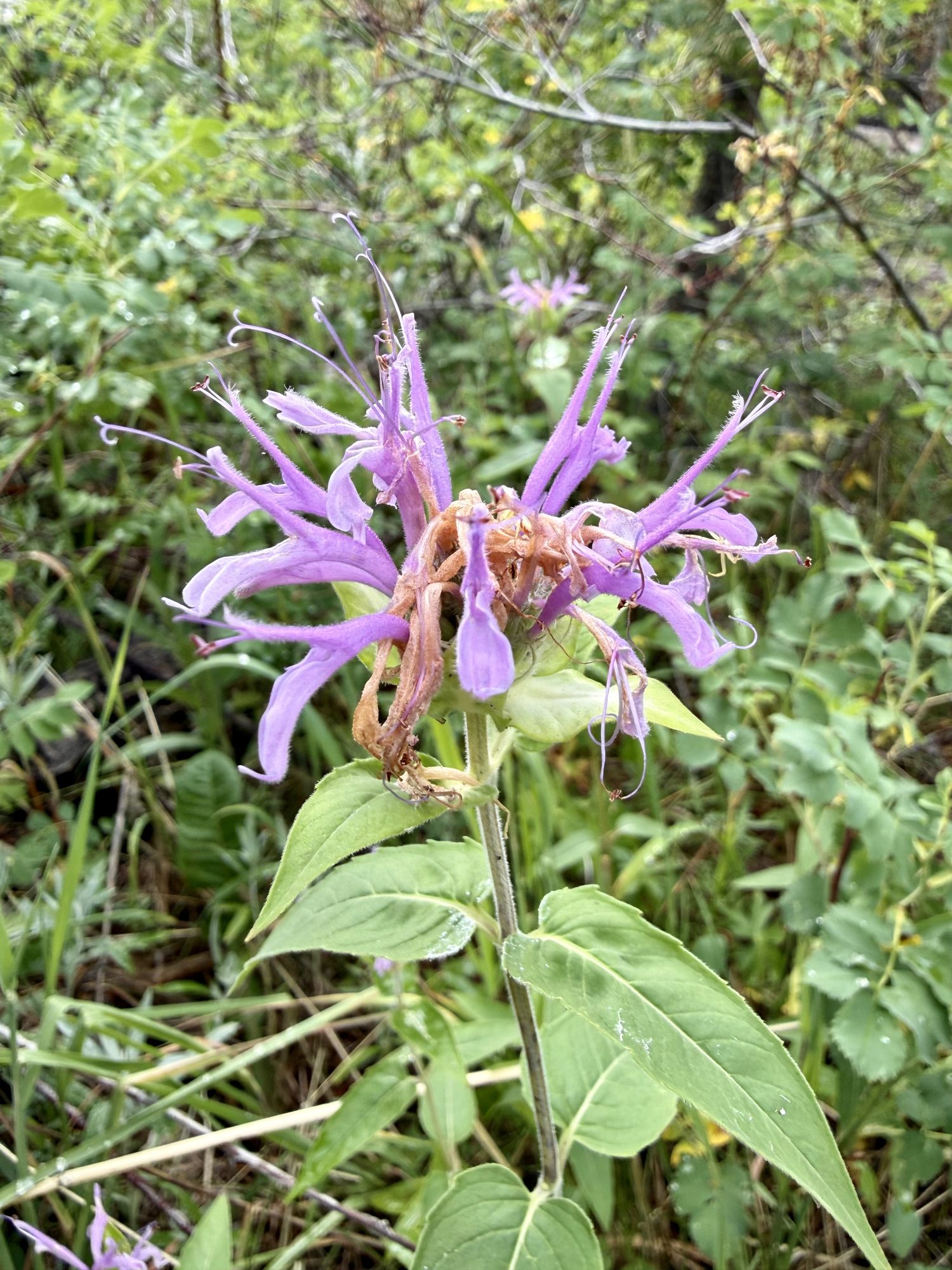
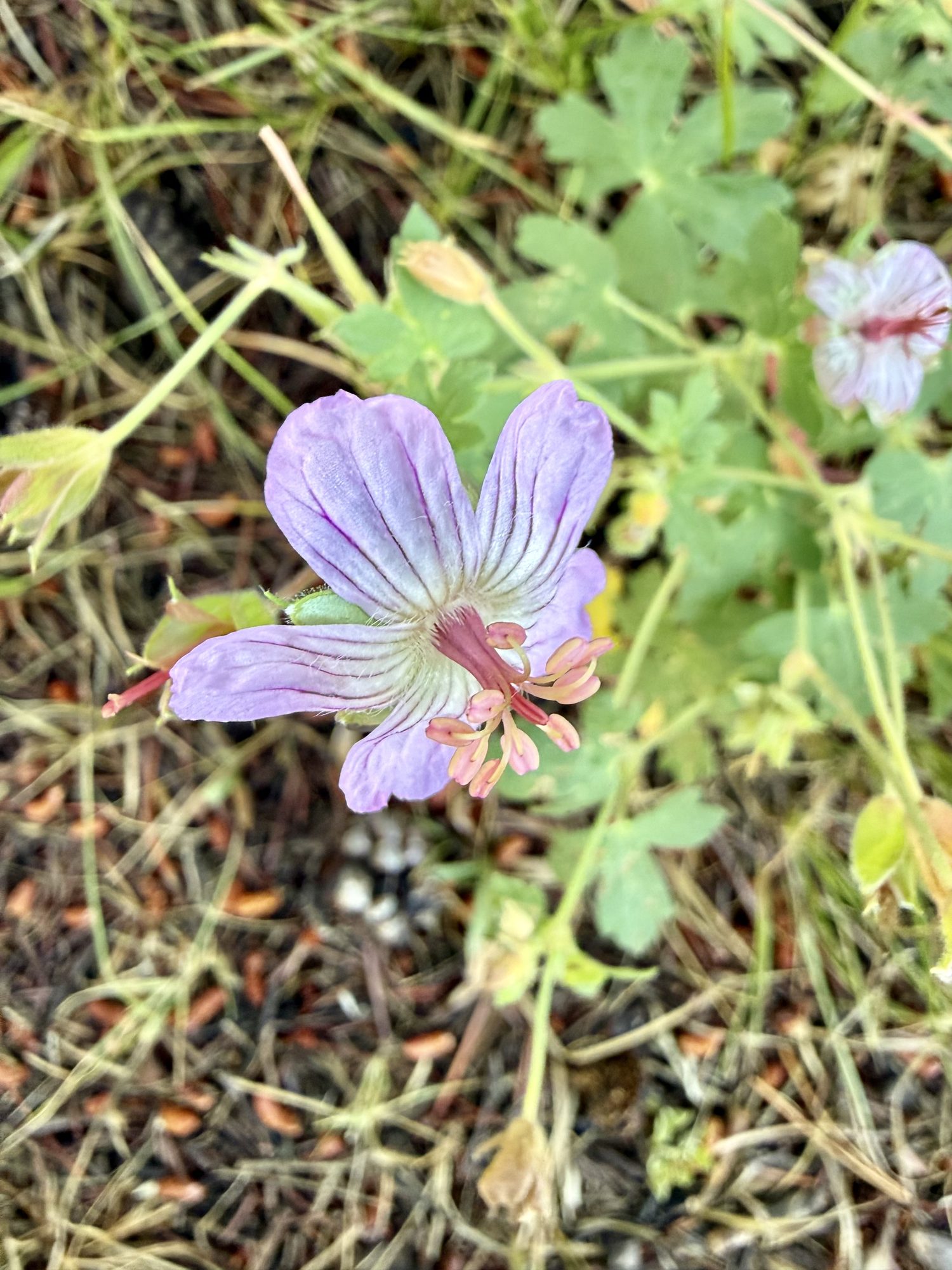
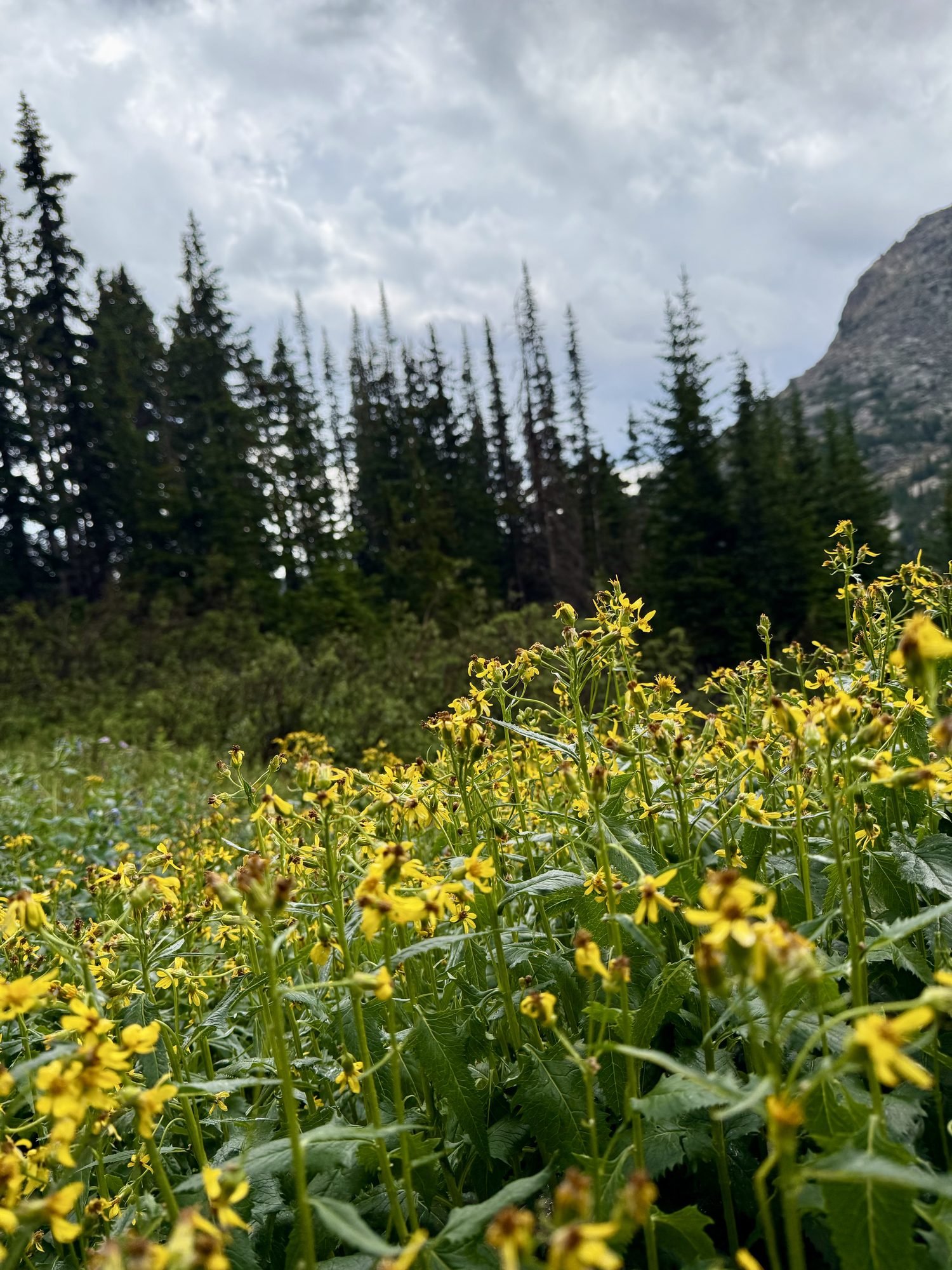
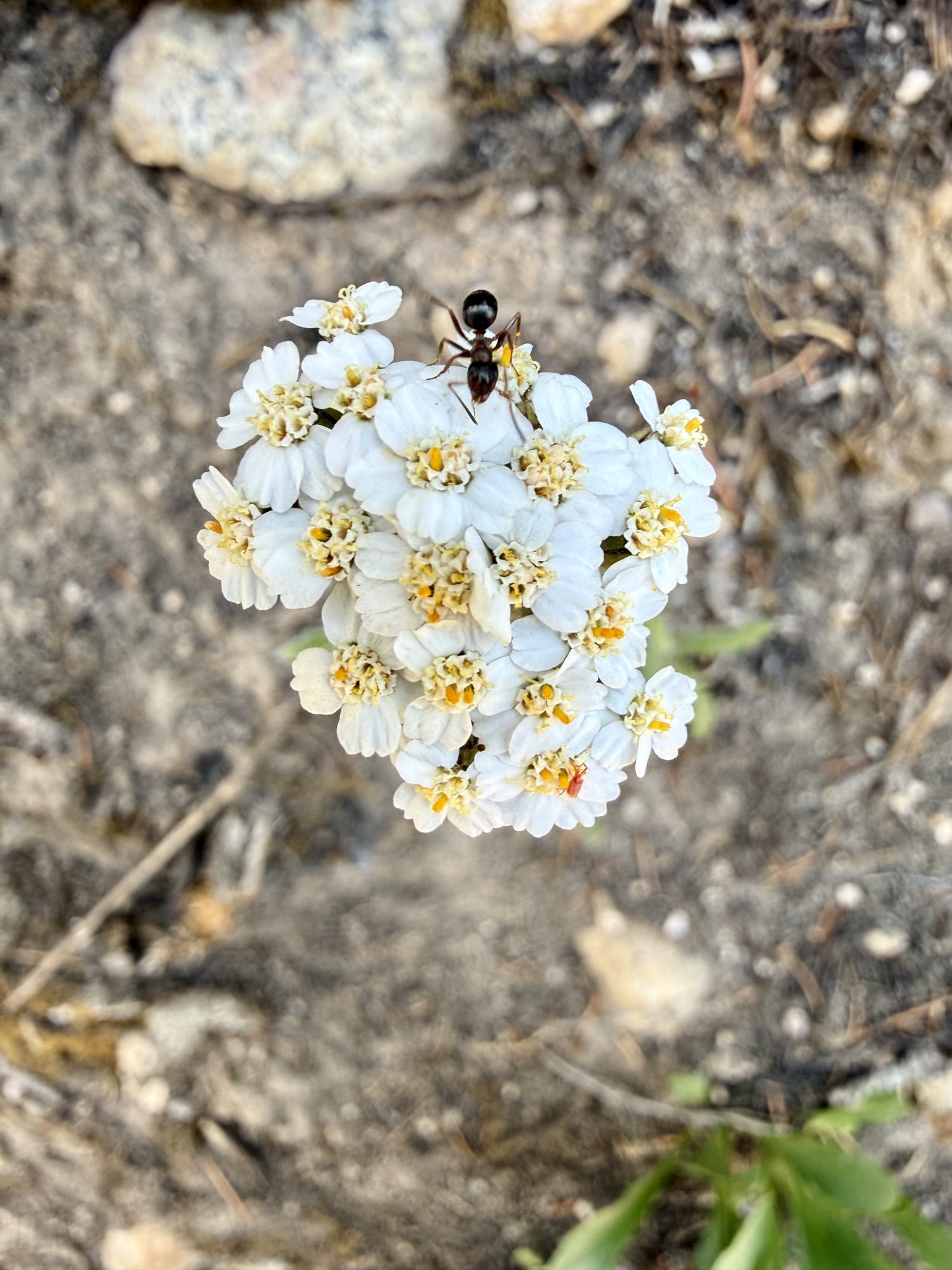
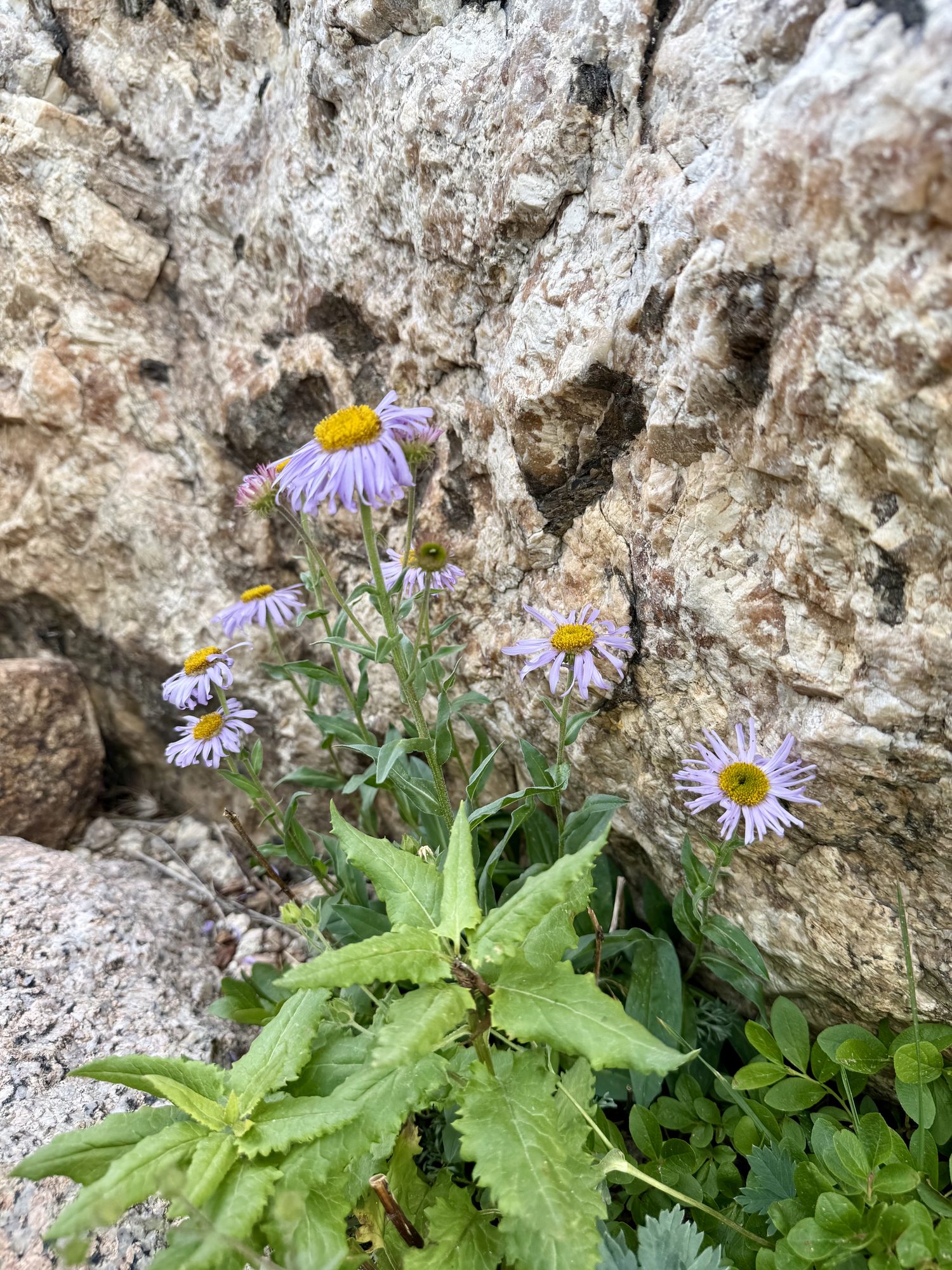
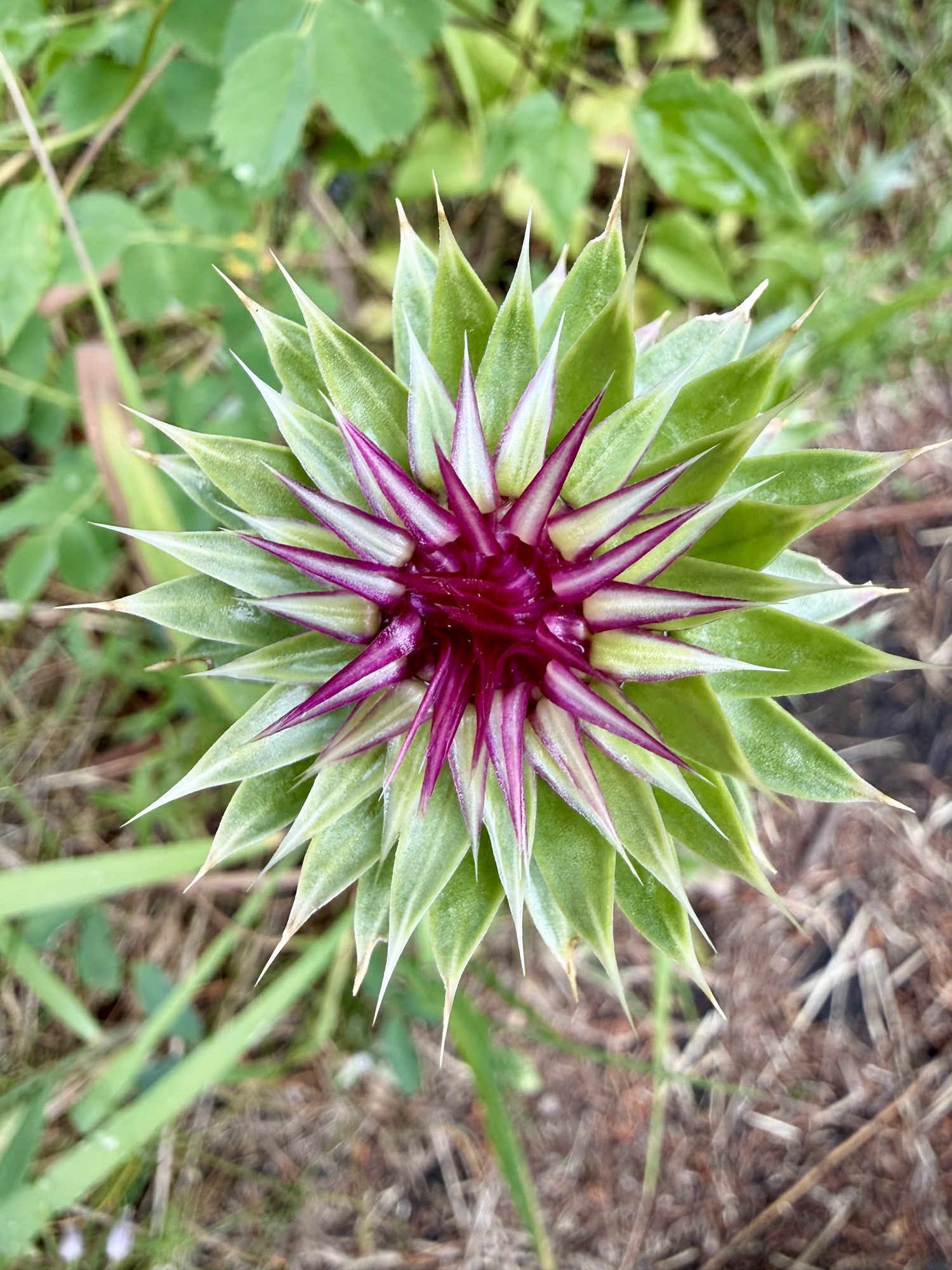
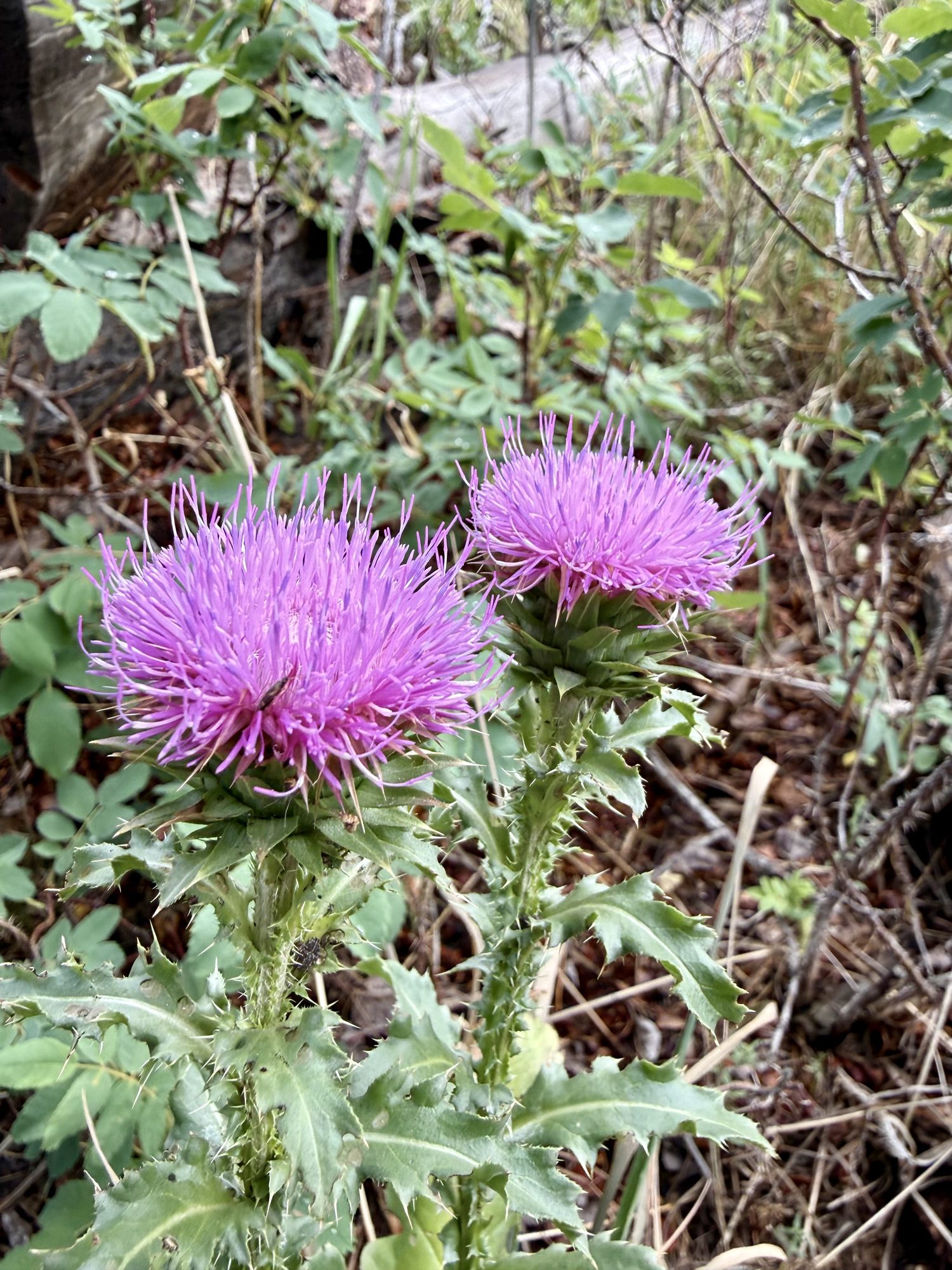
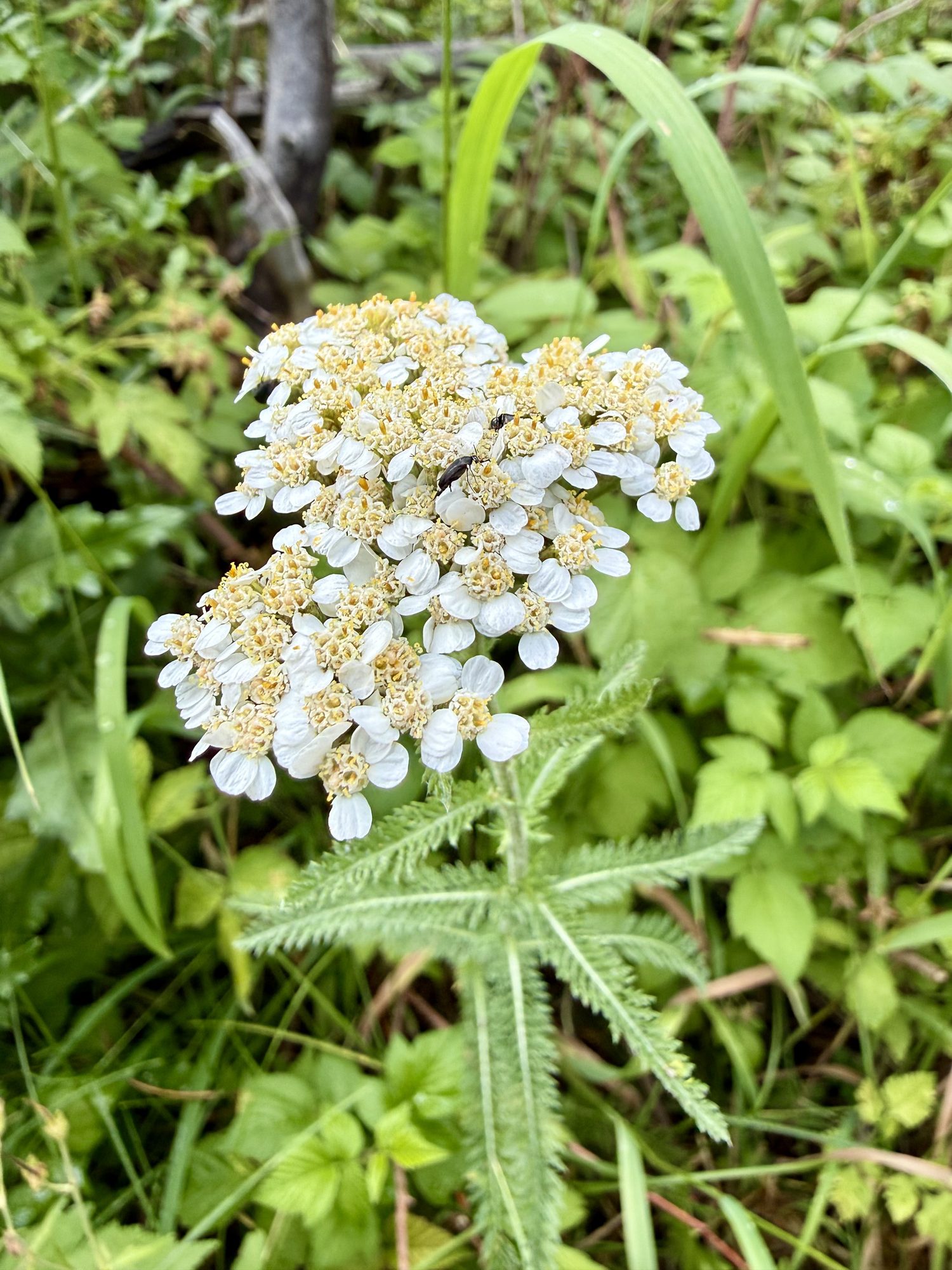
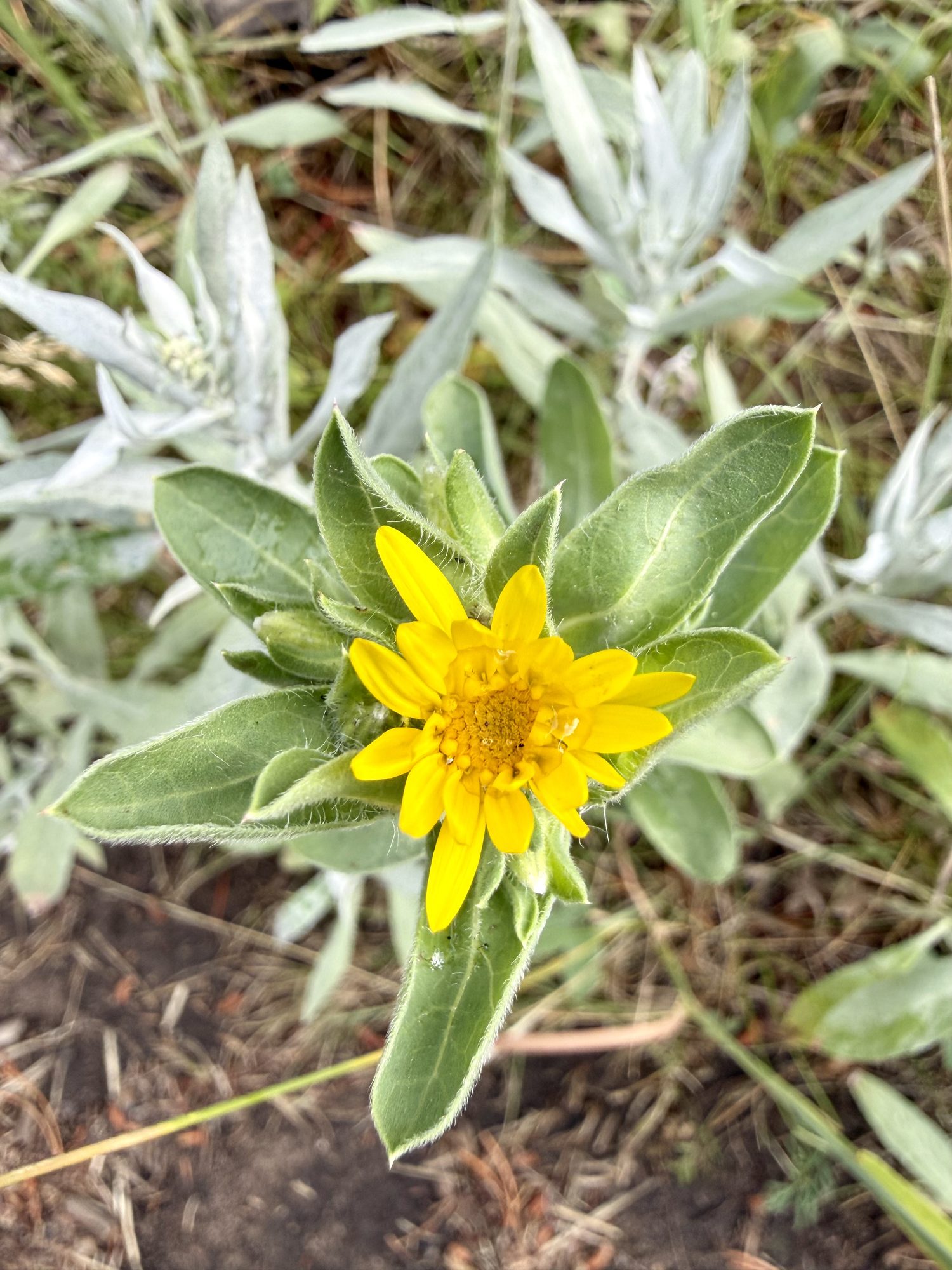
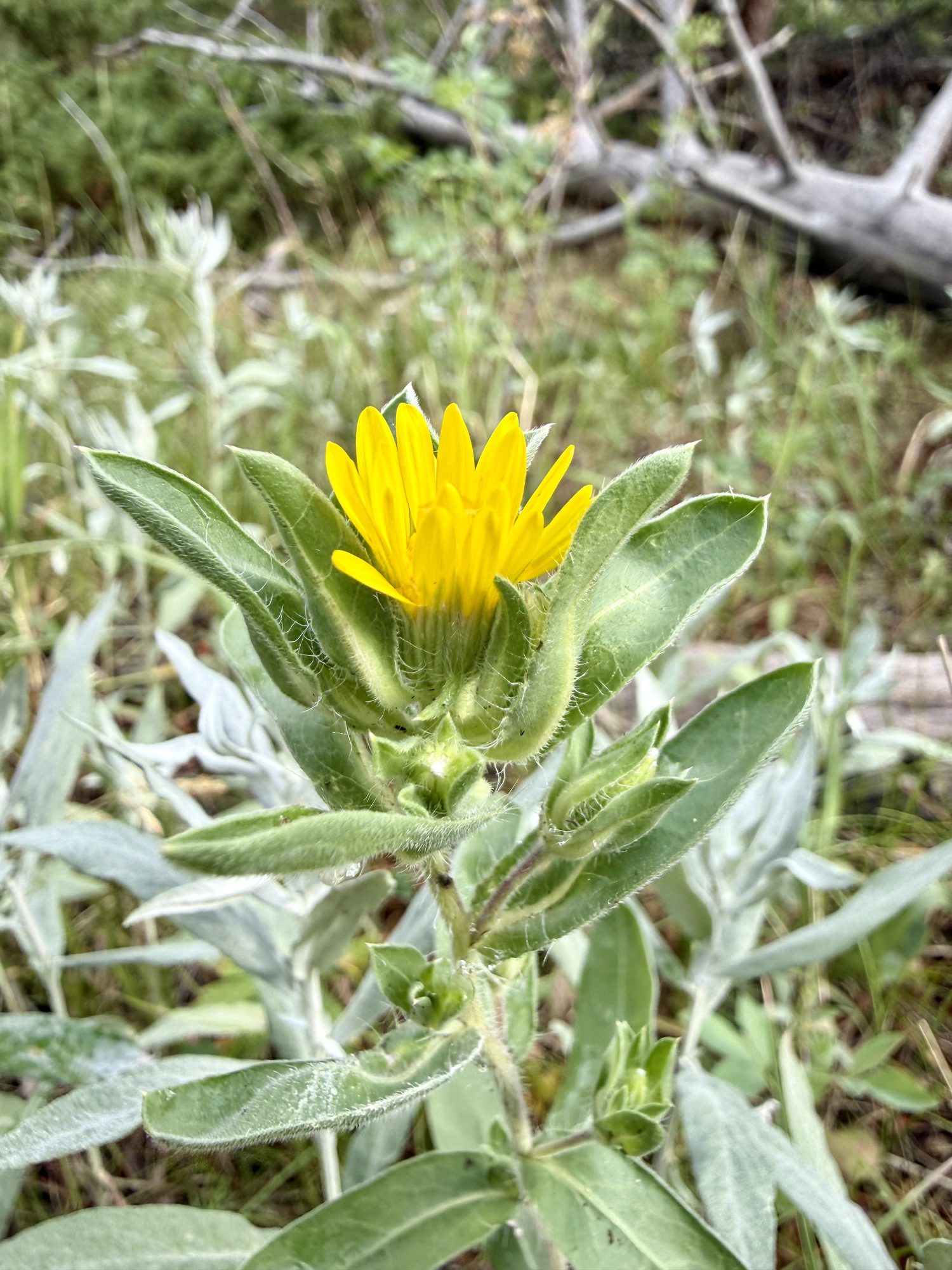
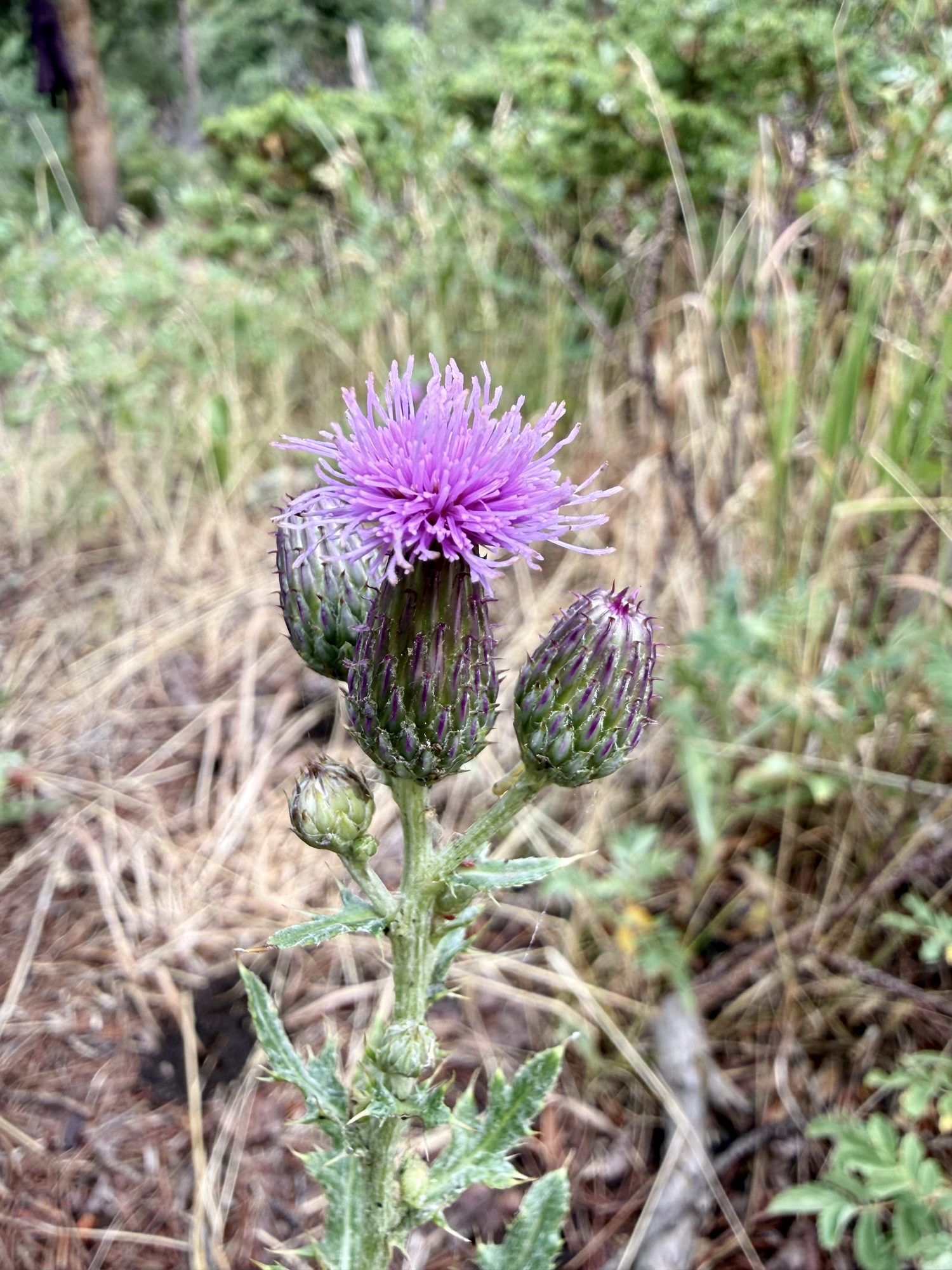
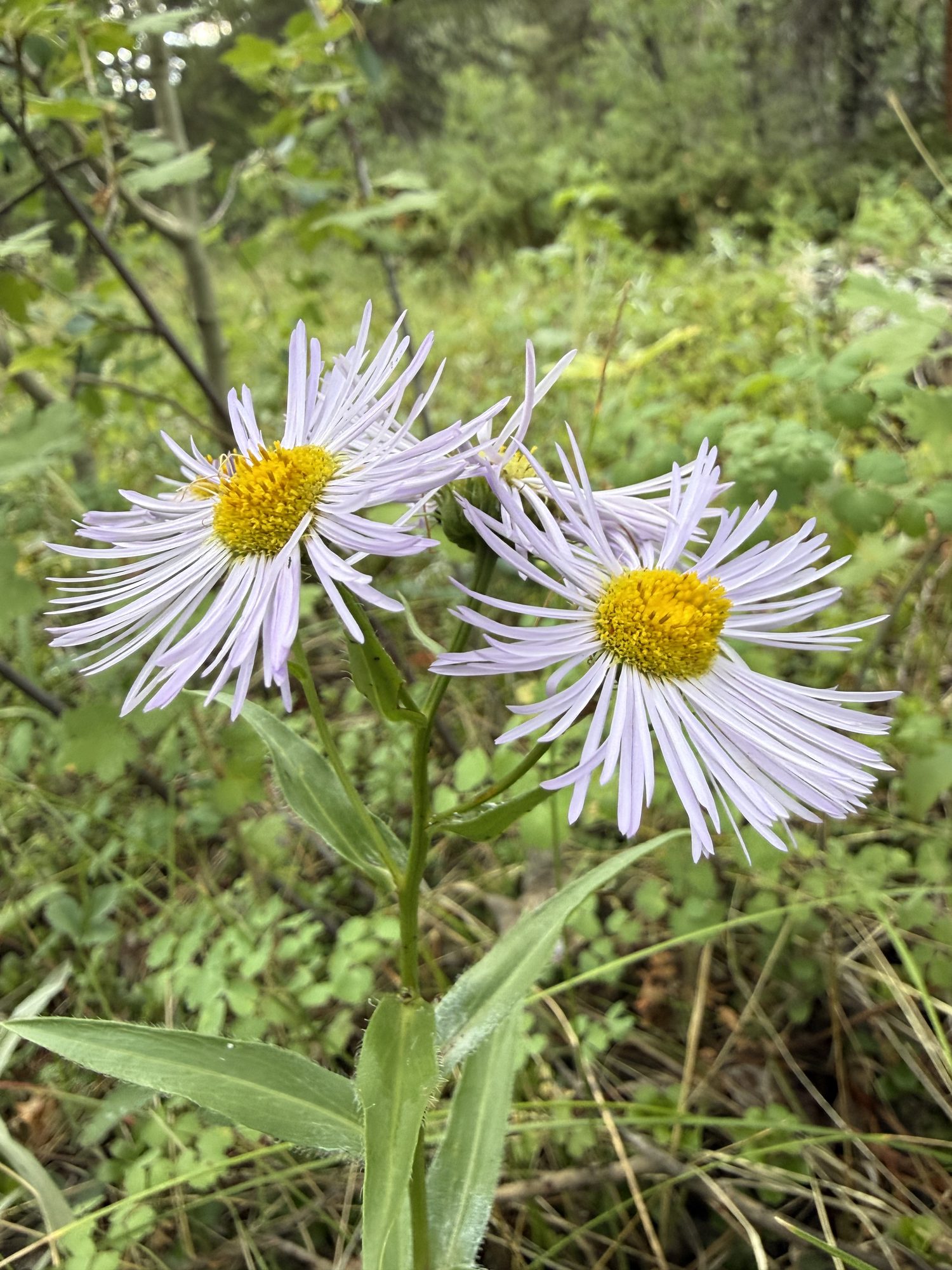
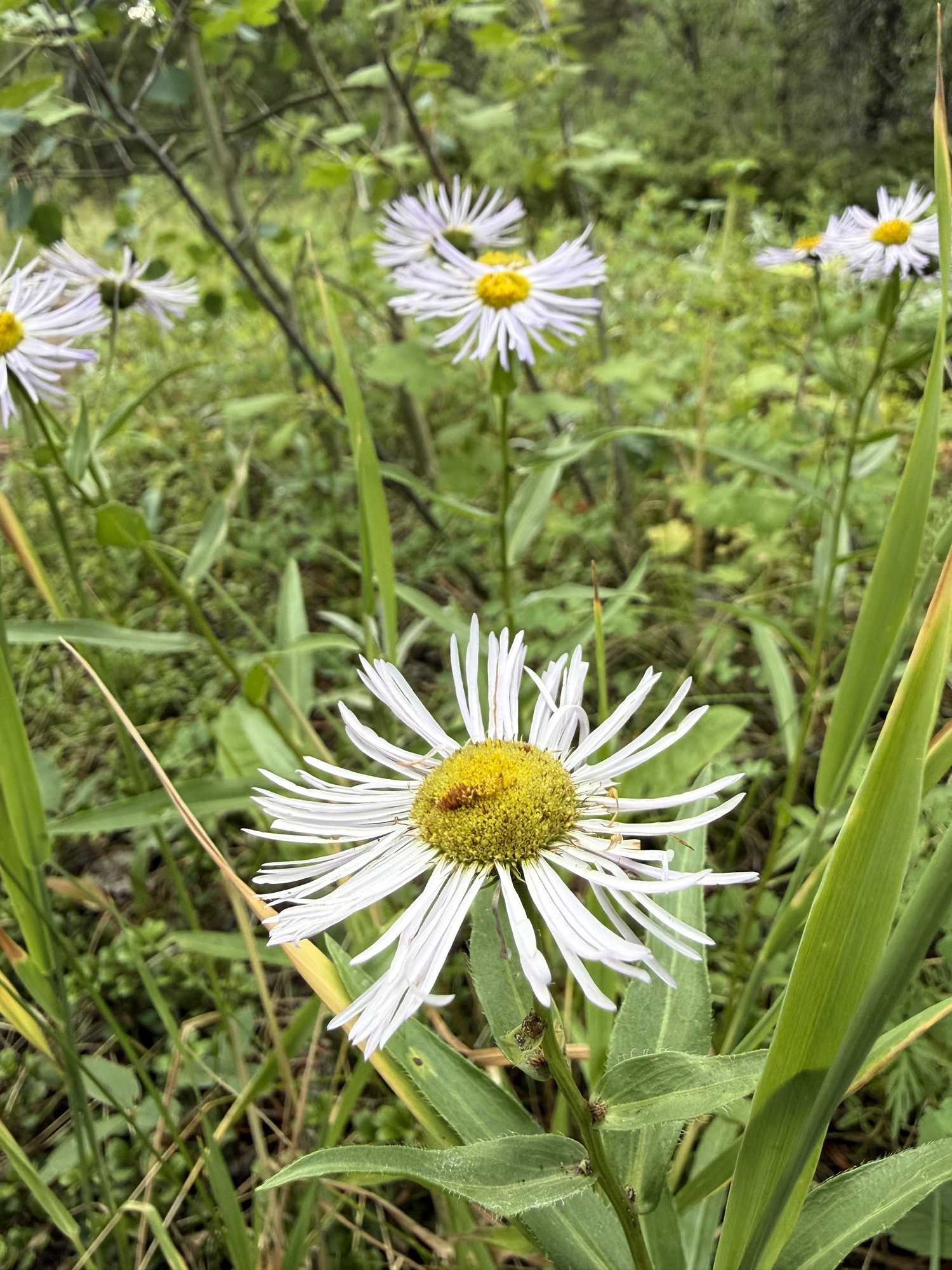
I photographed everything. Wildflowers: fleabane, mule-ears, yarrow, Solidago simplex. I saw my first marmot, which turned out to be the first of many, all of them radiating the same magnificent laziness. The sun was brutal all day and wore me down steadily, but I didn't much care.
About a mile out from camp we stopped to rest and I put my feet in the Roaring River. My feet had been doing excellent work and I felt they deserved something. Cold running water on tired feet after four miles under a pack is one of the great underrated pleasures.
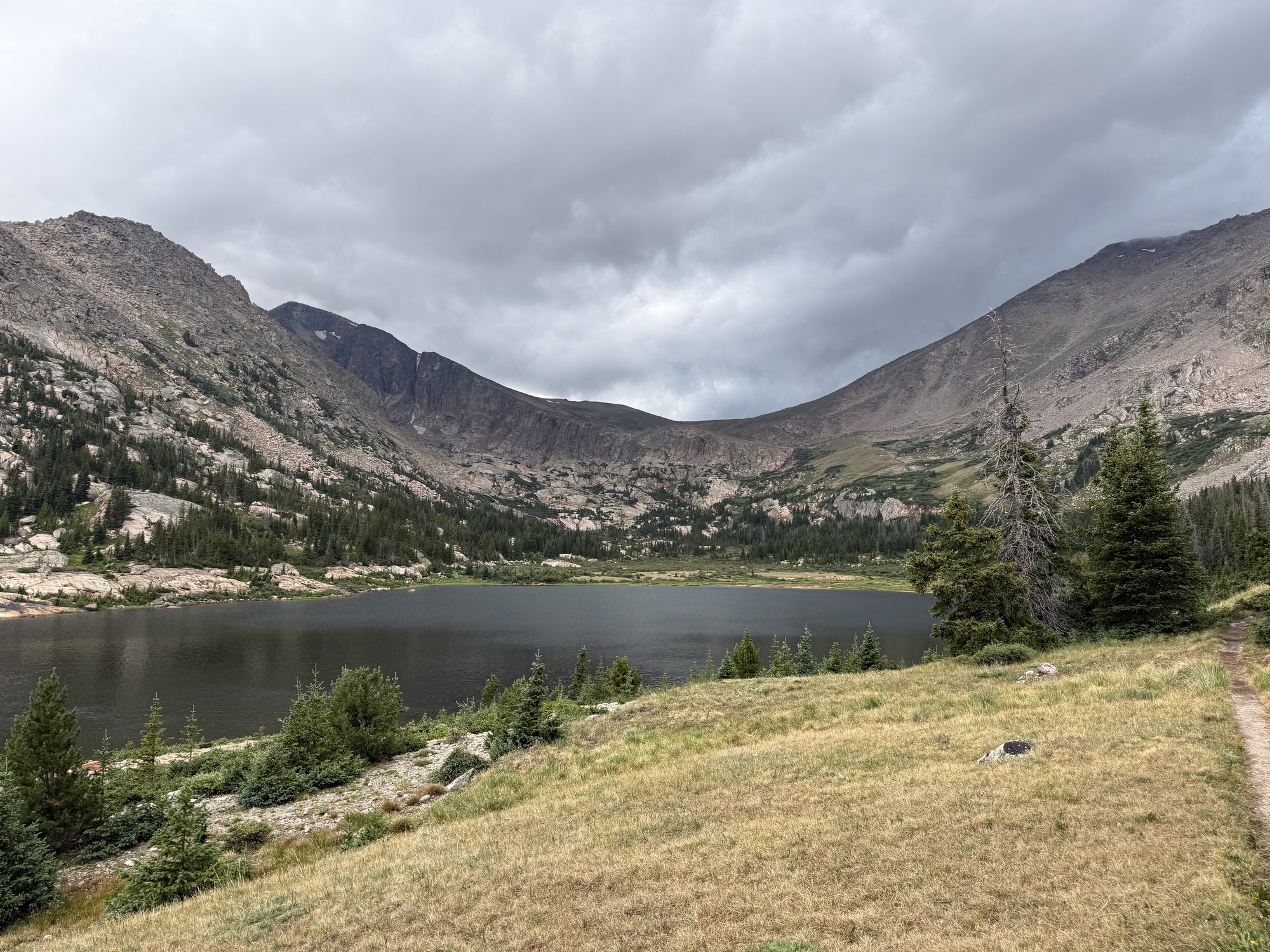
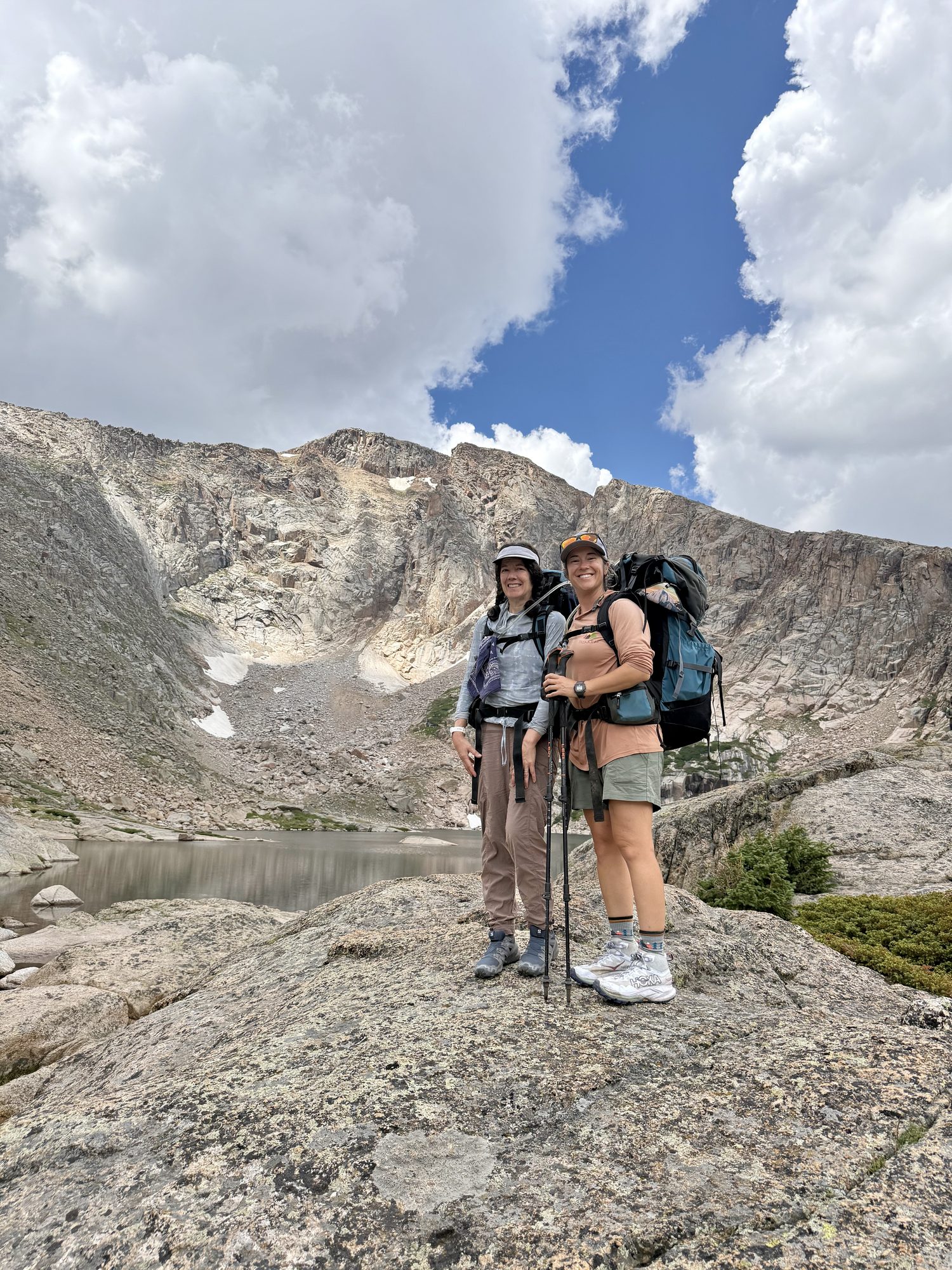
Then we came around toward the campsite and Lawn Lake appeared, the whole thing at once, with Mount Fairchild and Hagues Peak standing behind it. There are views you take a picture of and views you just stand in front of. This was both, in that order.
Camp at 11,000 Feet
The campsite was completely exposed to the sun, and after 4.5 miles of climbing in that heat, I did not have it in me to set up a tent. I stood there and looked at my tent bag and felt nothing but resistance. Looking around, I don't think I was alone in this.
Traci had us stow the food canisters in the kitchen area and started making lunch. Meanwhile Scott and I went to fetch water with a 10-liter bag and a 4-liter bag. The lake, unlike the river, wasn't flowing, and it turns out you cannot fill a 10-liter bladder by dragging it through still water. It just sort of shrugs at you. So we filled the 4-liter and used it to fill the 10-liter, one pour at a time, which is the kind of small backcountry problem-solving that feels absurdly satisfying.
After lunch, some people started setting up tents. I still wasn't ready. But watching others start moved me, the way it does, and I got up and set mine up too. Group momentum is a real force.
Also: the privy. I have to mention the privy. The signage pointed one direction, but the actual path was a maze of intersecting game trails and fallen timber, and finding the thing became the running comedy of the campsite. Almost nobody found it easily. Some, I suspect, never found it at all.
The Courage Negotiation
I had already told everyone I was going to swim in Lawn Lake. Melissa asked me to let her know when I went in. She said watching me do it would give her the courage.
But I was cooked. The sun had taken everything I had and I could not make myself walk down to the water. So I turned her proposal around: if you're ready, that'll give me the energy to get up and walk down there. Right now the heat is keeping me in the shade.
She agreed. Tyler came too.
I love this exchange more than almost anything else from the trip. Two people, both waiting for the other to make it possible, and the only thing that got either of us into the water was admitting out loud that we needed the other one to go first. That's not a hiking lesson. That's just a lesson.
Feet in first. A minute or two of standing there talking myself into it, the way you do. Then under, and it was tremendous. I sat in that lake for a good while and asked someone to take my photo, because I wanted evidence.
Melissa, having gotten me down to the water, made it knee-deep and stopped. Despite a full demonstration. I've decided this is fine.
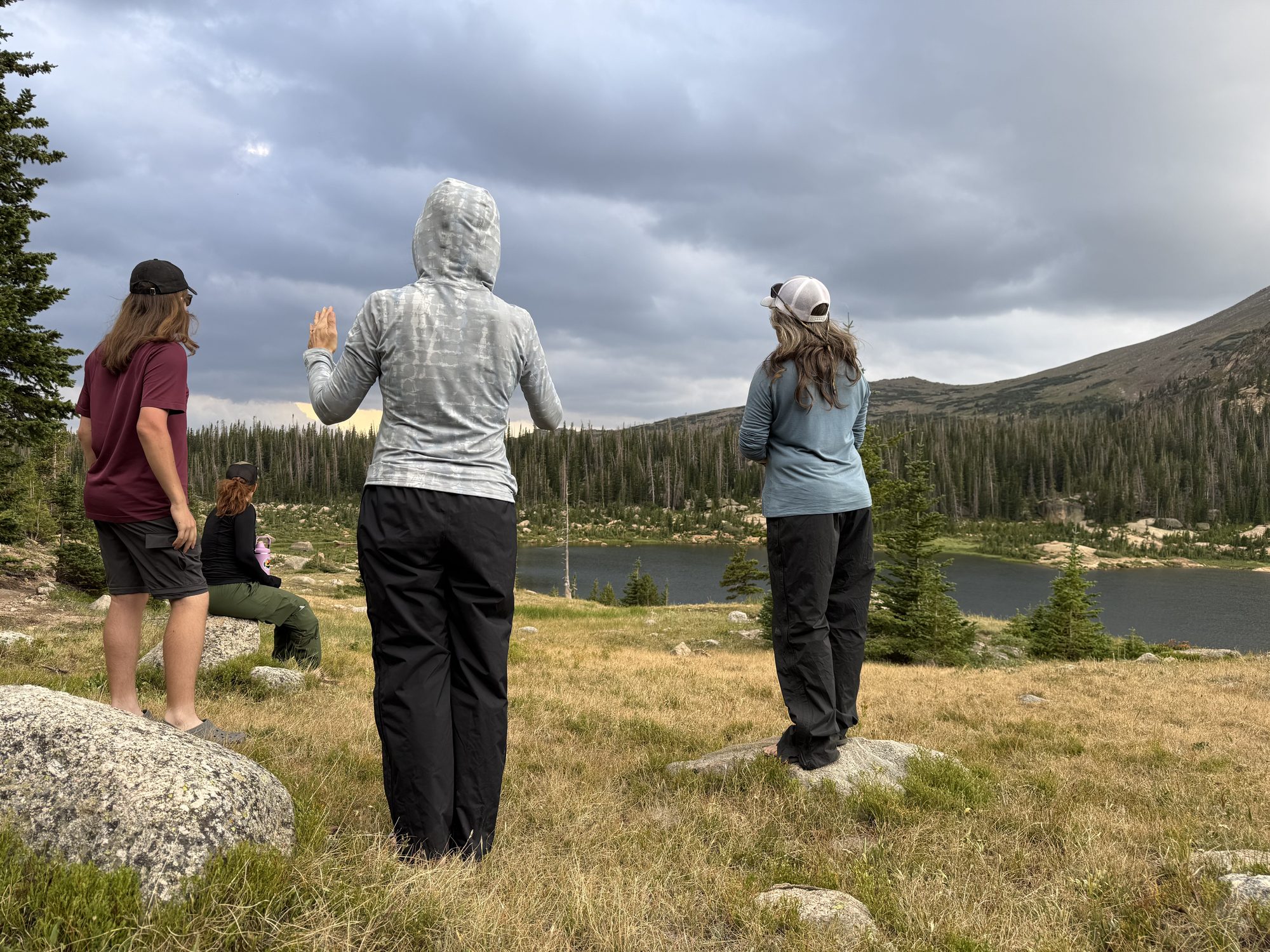
By the time I came out the sun had lost its edge. We sat on the rocks by the shore and kept talking, and somewhere in there we noticed the clouds stacking up above us, and the conversation turned to we should probably secure our gear.
We went back and put everything in the tents. This turned out to be one of the better decisions of the week.
7:15 PM
We set the tarp up over the kitchen area, the team-building exercise, round two, while Traci made dinner. We ate. Traci started the dishes. Scott, Melissa and I stayed to keep her company. Tyler and Debbie left for the privy, that ongoing expedition.
Then it started to drizzle.
We were still not tarp experts. Water began to pool in the low spots, and we took turns pushing it off, and this was fine and manageable and even a little funny for about ten minutes.
Then the drizzle became a downpour, and pushing water off stopped working, and we ended up simply holding the tarp up. All four of us, arms overhead, keeping the surface taut so nothing could collect at all. Traci finished the dishes in the middle of this. Then hail started, mixed into the rain. Then the hail got serious, and our fingers started to hurt where it struck them, and by the later stages the stones were marble-sized.
And we laughed. The whole time. That was our moment: the four of us trapped under a tarp in a hailstorm at 11,000 feet, arms up, hands stinging, absolutely delighted. This was real Rockies weather, the thing you read about in trip reports and can't quite believe. It felt like being let in on something.
But it went on. And on. Scott kept trying to read which way the storm was tracking, whether the sky was lightening anywhere, and every guess proved worthless. The storm just sat on us.
After a while the delight thinned out into something more practical. We couldn't confirm that Debbie and Tyler had made it back to their tents. Scott raised this with Traci, and I watched her recalculate. She knew the temperature would drop hard after dark, and six wet people at 11,000 feet is a different problem than six wet people at noon.
She asked if we were okay making a run for our tents. We were. On the way we confirmed Debbie and Tyler were safe inside theirs. Their water bottles were still sitting in the kitchen area, so I grabbed them and handed them off, on the theory that if this storm kept us tent-bound for hours, water would be worth having.
An afternoon of brutal, punishing heat had become an evening of water running from every direction and hail coming down like something had broken open.
Inside the Tent
My sleeping pad was already wet when I got in. Water was seeping through the sides and dripping from above. I stripped off my soaked clothes and got into dry ones.
Here I made my mistake of the trip. At dinner, when the clouds swallowed the sun and the temperature dropped suddenly, I'd reached for my puffer jacket instead of my rain jacket. Warm, yes. Waterproof, absolutely not. My puffer was now thoroughly soaked and useless.
Fortunately I had a spare sweater. Sweater on, rain jacket over it, and I was warm enough. But that's a lesson I'll carry. In the mountains, when the temperature drops suddenly, reach for the shell first. You can add warmth under a shell. You cannot add dryness to down.
Traci communicated with all of us by shouting between tents, which is its own strange kind of intimacy. Six people in five nylon rooms, yelling logistics into the rain.
She told us her own gear was soaked. Her tent sat slightly lower than ours and all the runoff was flushing around it. She asked for support, and I told her we'd find a way to share space if it came to that.
Then she started thinking out loud about risk. Options on the table: hike down to warmer elevation, or try to get into the ranger's cabin less than a mile away.
I pushed back, gently, but I pushed back. My argument was that moving six wet, tired people through a hailstorm in fading light introduced more risk than it removed, and that we should stay put, stay in our tents, and reassess in the morning when we could actually see the weather. Everyone agreed. We stayed.
After about an hour and a half, it cleared.
I got out to see if anyone needed help. Traci came out too and asked Debbie and Tyler if she could move into their larger tent, and they said yes immediately.
My own sleeping pad was still wet, so I'd laid my backpack's rain cover over the top of it and kept my rain gear on, a dry layer between me and the wet. I mentioned this to Traci and suggested that if we had any plastic or similar material, we could do the same for the other wet pads.
She immediately said: trash bags.
Of course. Trash bags. She dried her tent out with Debbie's quick-dry towel, laid trash bags over her pad, and slept in her own tent after all.
Once everyone confirmed they were set, we called it a night, and slept hoping the sky would leave us alone.
Day 3: The Best Day
Day hike to Crystal Lake. 3.5 miles round trip, up to about 11,500 feet.
I slept badly. I'm still not sure why. Possibly the residual damp. Possibly some part of my brain listening for thunder. Possibly just excitement, because I'd watched the Rockies go from brutal heat to freezing hail in the space of an afternoon and my head was still processing it.
Traci announced a change of plan over breakfast. We'd been scheduled to summit Mummy Mountain. The forecast said no. Instead, a day hike to Crystal Lake.
Nobody reacted. I think everyone understood. And later, on the way back down, we could see Mummy Mountain wrapped completely in cloud. The weather was already there, doing exactly what she'd said it would do. The right call, visibly confirmed.
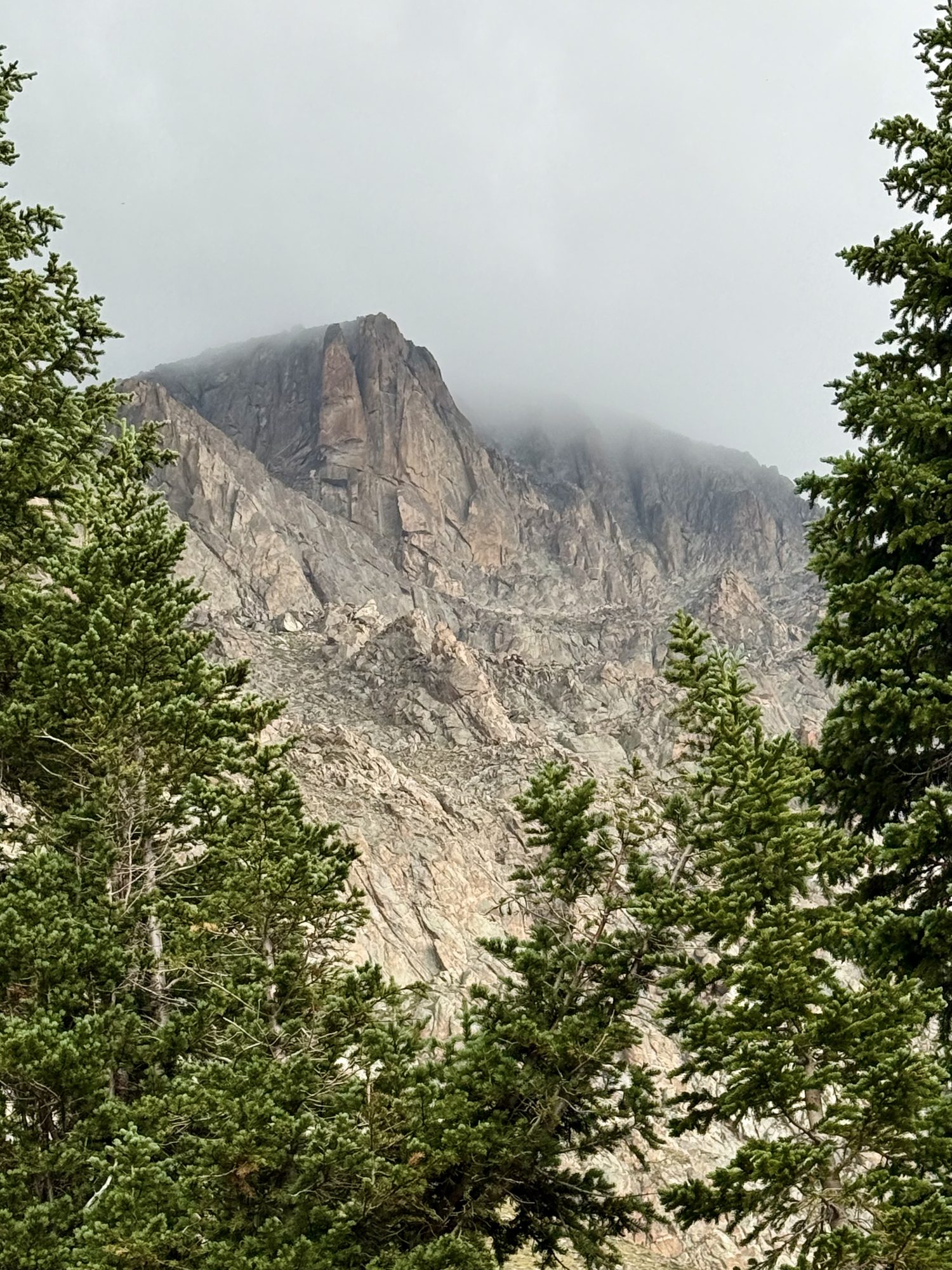
The morning gave us sun, so we hung everything wet out to dry while Traci made breakfast, and the sun was generous. It was all dry before we left. Then we packed it all back into the tents, because afternoon thunderstorms were expected and we'd learned that lesson thoroughly.
We started around 10:30 and were at the lake just before noon.
Alpine
With just a day pack, the hiking felt like flying. And the terrain gave us everything.
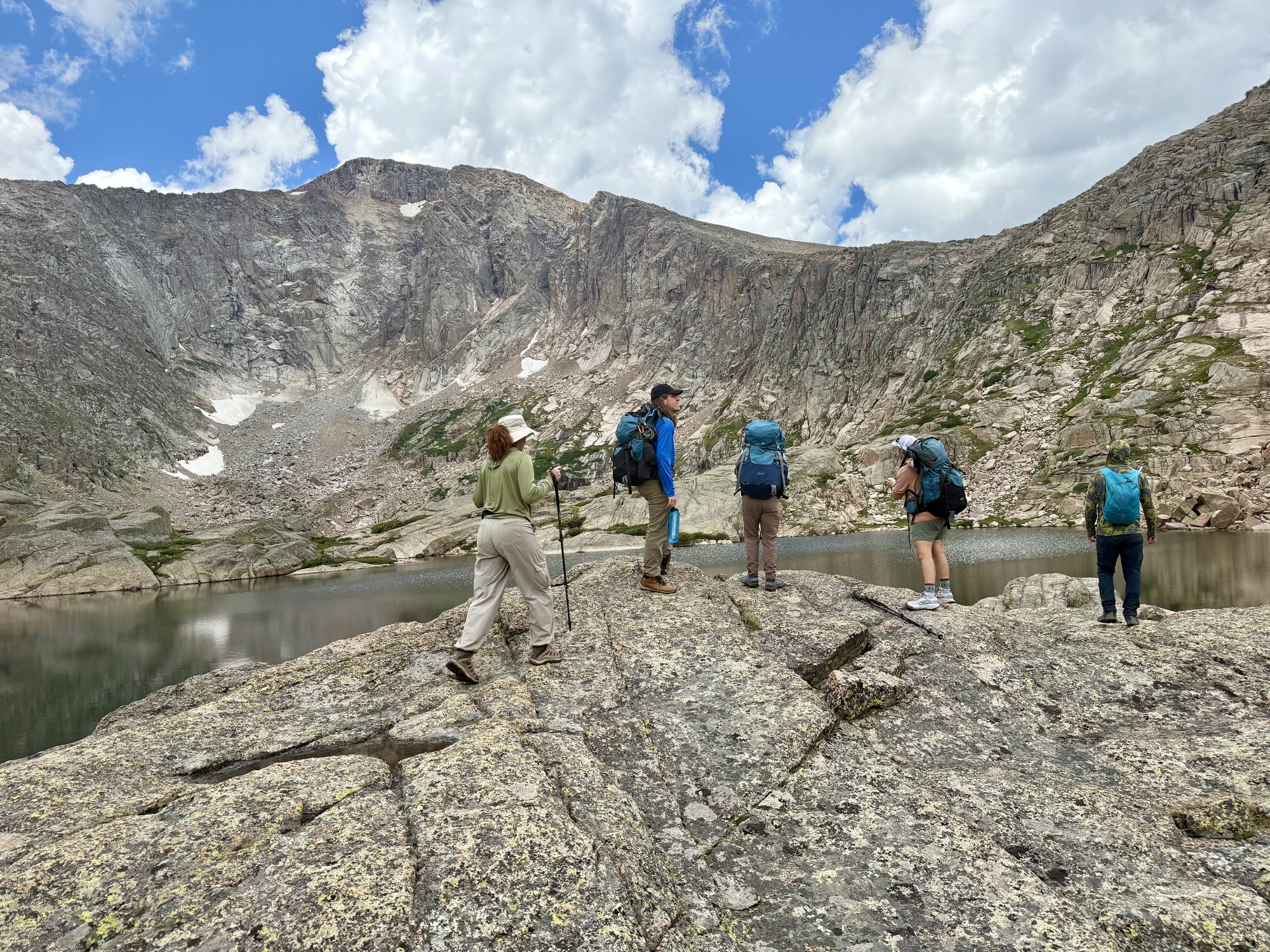
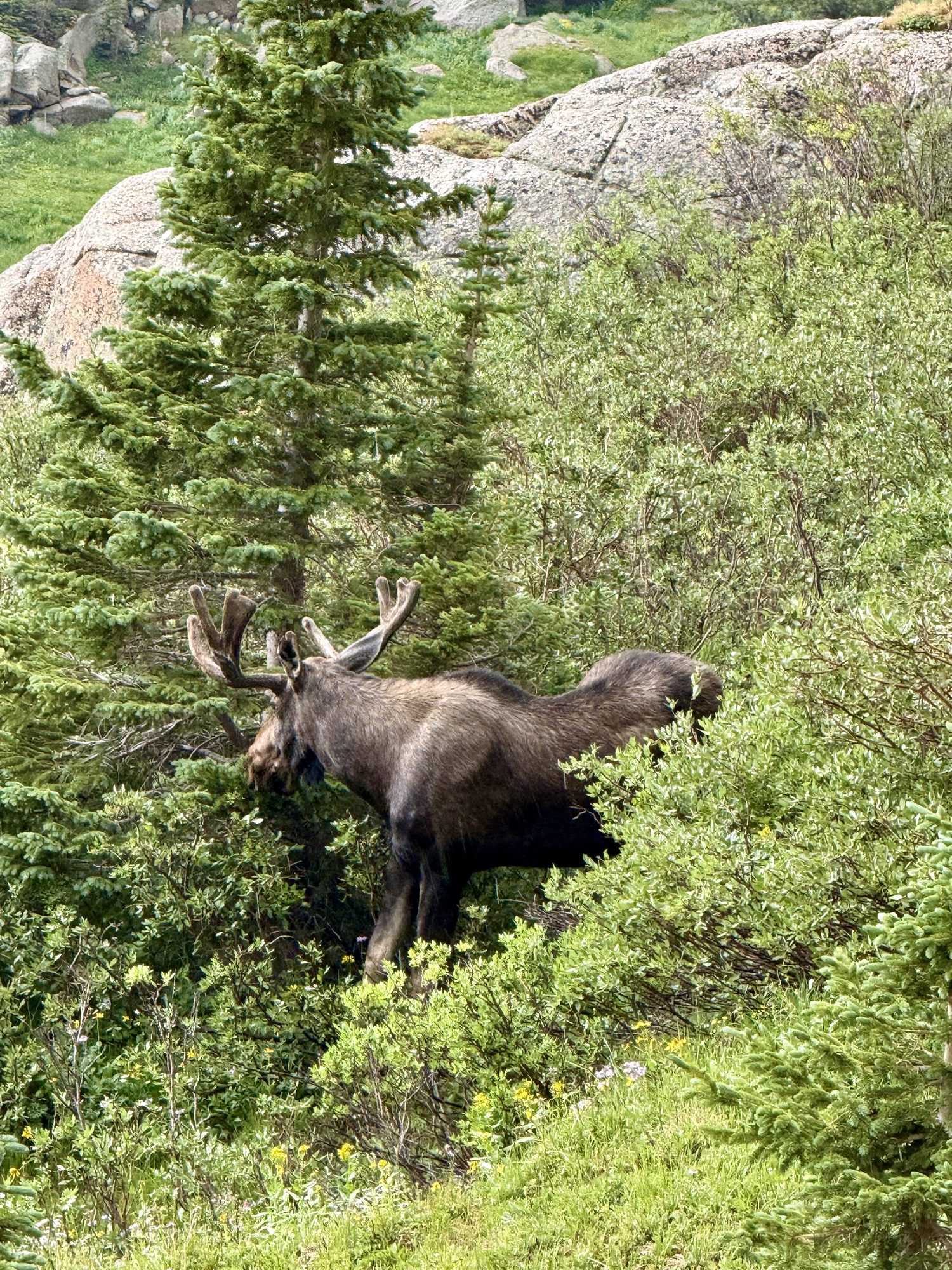
Wildflowers again, in quantity. Marmots sunning themselves with total commitment to doing nothing. Mule deer. And a moose, which was the single most exciting wildlife sighting of the trip for me. Streams, small lakes, and the kind of open alpine landscape that makes you stop mid-sentence.
Crystal Lake itself was turquoise. Actually turquoise, the color you assume is a filter until you're standing in front of it.
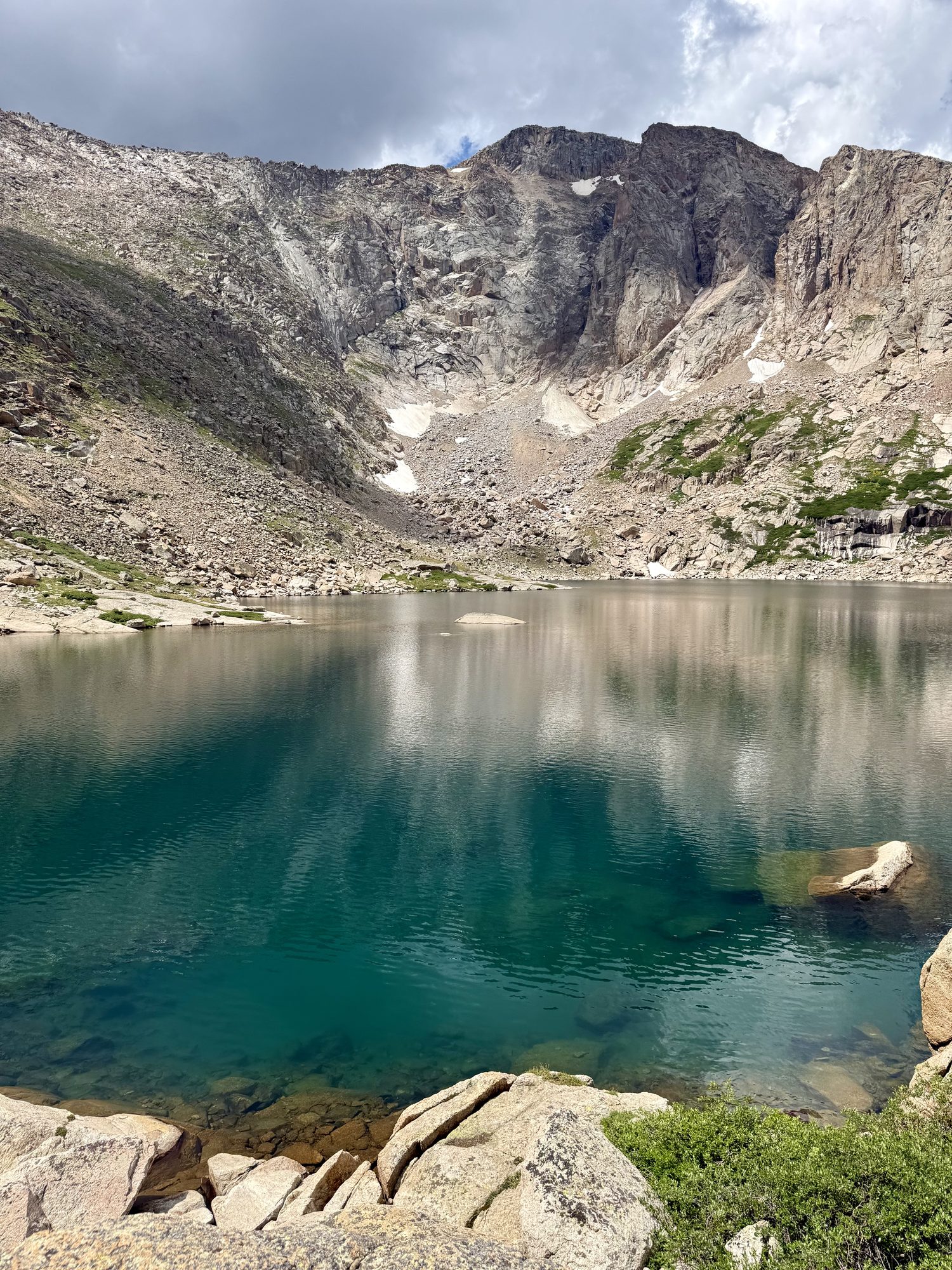
I took a lot of photographs. This short, easy day hike turned out to be the richest photographic day of the entire trip, which is a decent argument for the value of not carrying much.
Clouds started forming and we headed down without lingering, but we didn't rush either. Enough time to be there properly. It hailed a little on the descent, but nothing like the night before.
If someone asks me what the best day of the trip was, this is it. Alpine views, the best wildflowers, the best wildlife, and a lake the color of a postcard nobody would believe.
Tent Jail
We got back to camp safely and Traci made lunch, and almost immediately after we ate, the rain arrived and stayed. We were in our tents from early afternoon until about seven in the evening.
Melissa named it: tent jailed.
I served my sentence asleep. A long, deep, thoroughly earned nap.
After dinner we stayed out until dark. I assumed the nap had destroyed any chance of sleeping that night, but I started going through the day's photographs in my tent and got drowsy faster than expected. I apparently fell asleep with my glasses on.
This campsite had a ninja squirrel too, incidentally. Competent, but not in the same league as the one at Golden Banner.
Day 4: A Forest of the Dead
Lawn Lake to Peregrine Camp. 7.5 miles, from 11,000 feet down to 8,300.
Our longest day, and almost entirely downhill.
The morning was cloudy with no sun, so we packed wet tents, one of the small miseries of backpacking, stuffing damp nylon into a bag knowing you'll have to deal with it later. We hit the trail around 10:45.
The trail itself I found dull. It follows Black Canyon Creek and then Cow Creek down, and there are no views, no scenic set pieces. Just walking beside water, which is pleasant enough but doesn't ask anything of you.
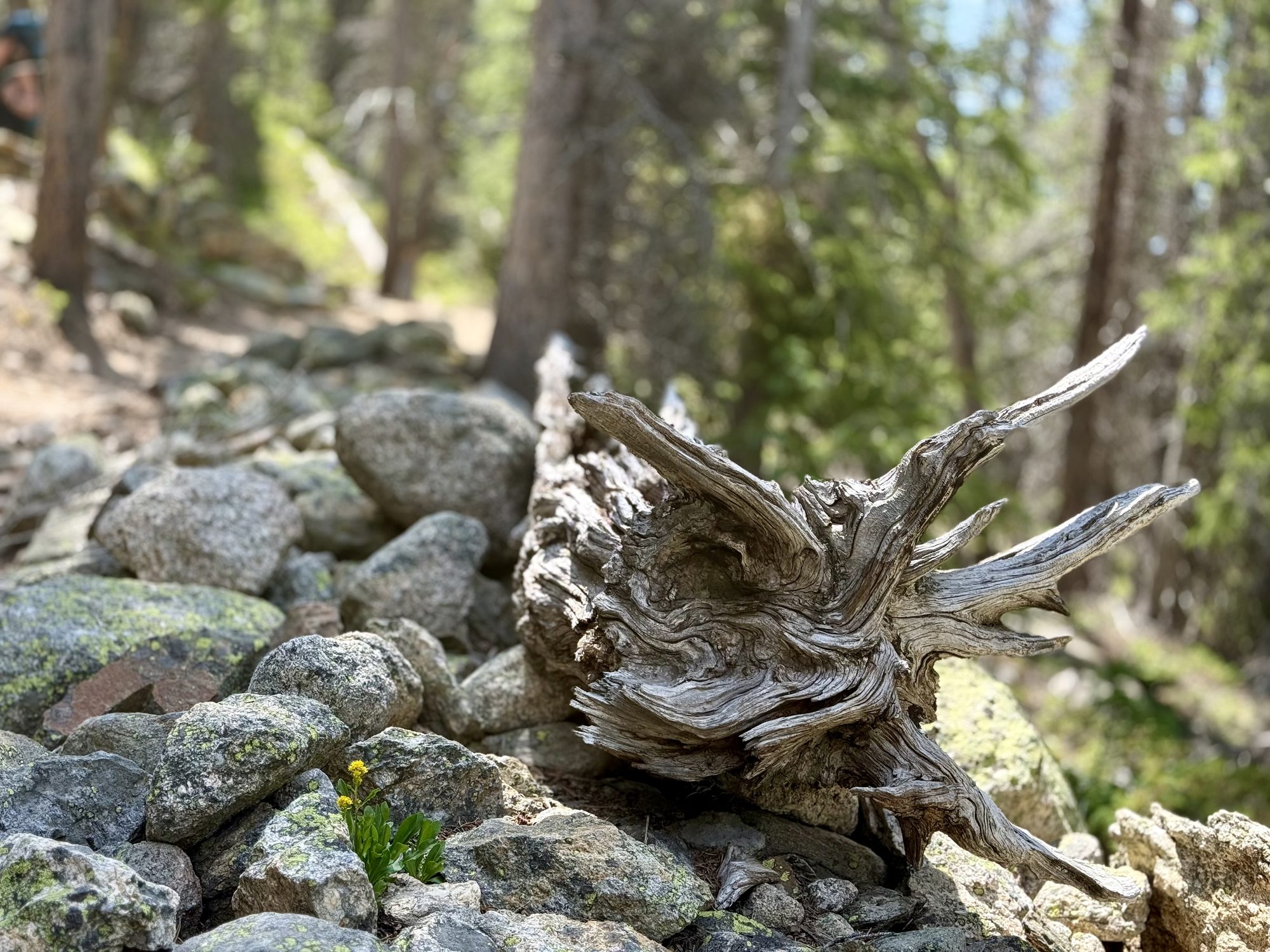
What I couldn't stop looking at was the dead trees.
There were so many. Mile after mile of standing dead pine, gray and bare, still upright, in numbers that stopped registering as individual trees and became a landscape condition. Traci told us what we were looking at: mountain pine beetle kill. She called it a graveyard.
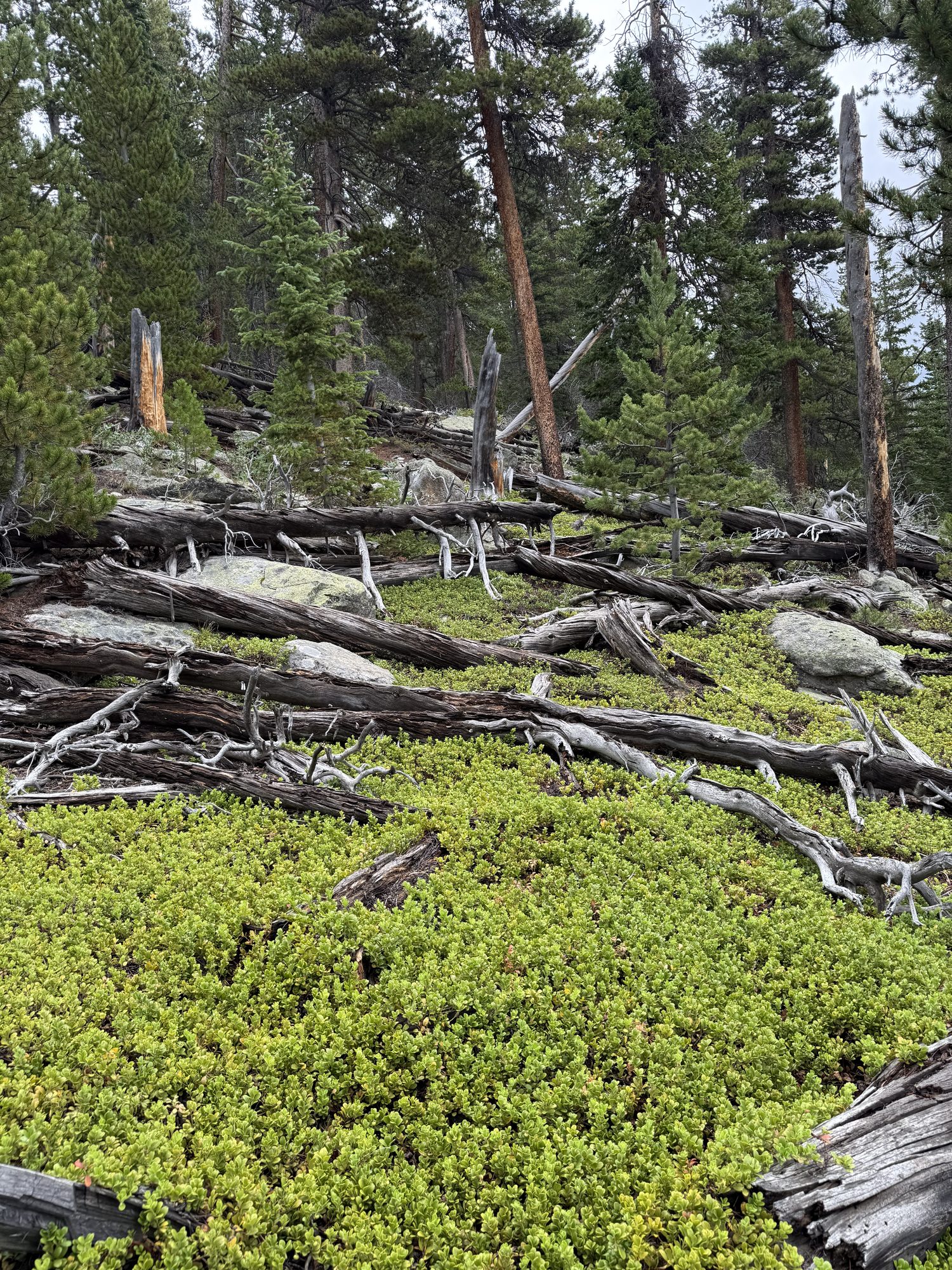
I understand why she said that, but I don't think it's right. A graveyard is a place we make. We bury people we knew, we mark them, we come back. What we were walking through had none of that. This looked like the aftermath of a disease or a war, bodies left standing where they fell, with nobody left to claim them.
My immediate reaction, walking through it, was alarm. This felt like one lightning strike away from a catastrophe. And I found myself thinking that the campfire bans, while sensible, are almost beside the point at this scale, and that the park should be clearing this dead timber urgently.
I read up on it after I got home, and it's worth reporting honestly what I found, because my gut reaction was half right.
The scale is worse than I understood while walking through it. The southern Rockies have been through the most severe recorded mountain pine beetle epidemic in history over roughly the last fifteen years, and lodgepole pine mortality in Rocky Mountain National Park has approached one hundred percent in some stands. Drought, unusually mild winters that failed to kill overwintering beetles, dwarf mistletoe infestation, dense mature forest, and decades of fire suppression all combined to make it possible.
But the wildfire connection, the part I was most confident about while standing there, turns out to be genuinely contested among scientists. The intuitive case is that stands full of standing dead trees with dry red needles carry a higher crown-fire risk, and that's a real position held by serious people. But a number of Colorado researchers dispute that beetle-killed forest meaningfully increases overall fire risk, and the science hasn't settled. The park does conduct selective hazard-tree removal and has run test burns in beetle-killed stands specifically to study how fire behaves there.
I'm leaving my reaction in this account exactly as I felt it on the trail, because it was real. But I'd rather be accurate than certain. What I saw was devastating. What it means is more complicated than what I concluded in the moment.
We ate lunch along the way. It was a long, hot walk and the sun ground all of us down.
Peregrine Camp
We reached Peregrine Camp around 4:30, right on Cow Creek.
By this point in the trip, my relationship with cold water had become a group fact. Traci pointed at a spot as we came in and said, there's a nice place for Anup to swim.
We set the tents up faster than we had all week, entirely because of what was waiting. I announced I was going in and said people could join whenever. Everyone came down and got their feet in. Once again, I was the only one who went fully under, and I stayed under a long time.
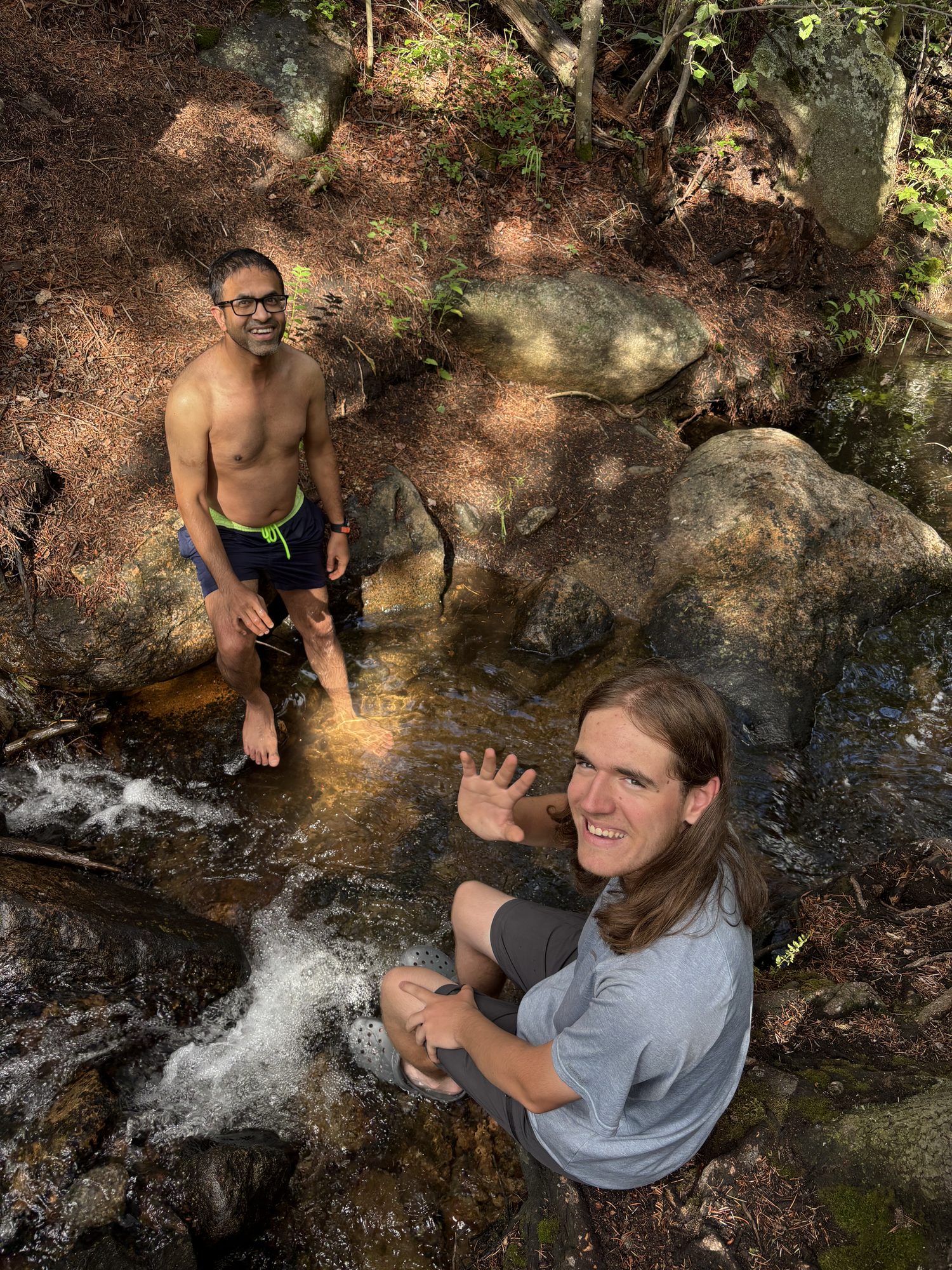
Afterward we sat with our feet in the creek and talked until it was time to think about dinner. No wildlife at this site, and only a few wildflowers.
In the evening, Traci made dinner while we put the tarp up, because rain was forecast. Still not tarp experts. It rained after dinner, the tarp sagged, we pushed water off it again. This time it stayed manageable.
Before we turned in, Traci briefed us on the final day: up to Bridal Veil Falls, then out to McGraw Ranch, where Floyd would be waiting with lunch.
Day 5: Out
Bridal Veil Falls and McGraw Ranch. 4.5 miles.
We wanted to be moving by 8:30. We ate, packed, and were on the trail by 8:45, which for a group of five on the last morning is basically punctuality.
Up to Bridal Veil Falls first. Again, not a dramatic trail, but Cow Creek running alongside made it pleasant, and there was none of the dead timber from the day before, which I noticed with more relief than I expected.
Most of the way was shaded, though the sun was out and the heat was climbing.
From the falls we backtracked to the Cow Creek trail and turned toward McGraw Ranch. Easy walking, mostly gradual descent, and we didn't stop much. There's a particular rhythm to the last few miles of a trip where everyone quietly agrees to just march. The meadows were fully exposed and the sun there was punishing, the last hard thing the trip asked of us.
We reached the ranch just before noon. Floyd was already there with lunch waiting in the cooler.
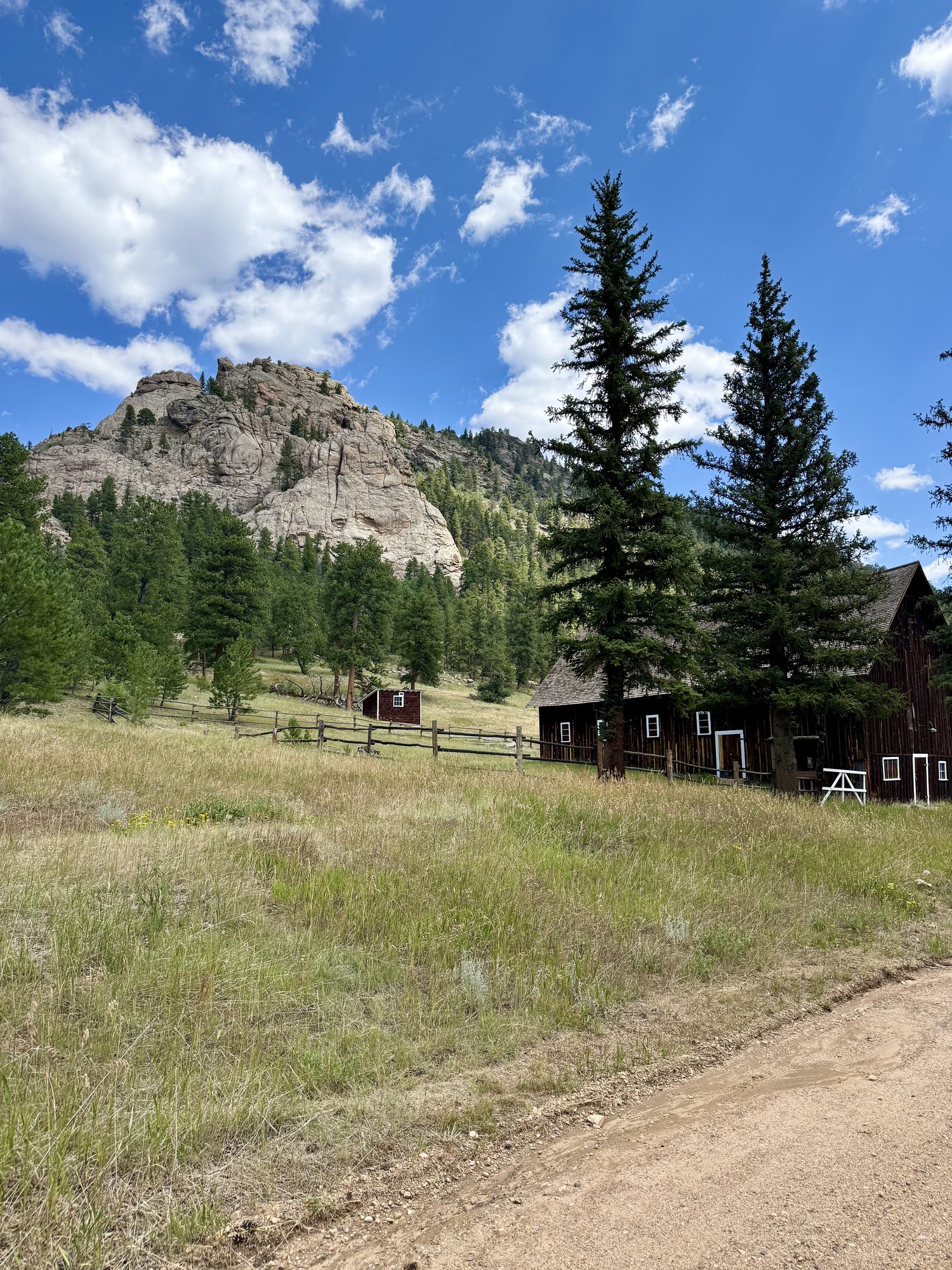
The goodbyes were warm. Everyone thanked everyone. There was a lot of that was really fun going around, and it was true.
On the drive out I collected everyone's phone numbers so I could send them photographs. All of it was shot on my iPhone. I didn't bring a camera. What I did bring was a willingness to stop constantly, for a flower, for a marmot, for the light doing something on a ridge, for the group strung out along a switchback. By day five everyone had noticed how often I was stopping, and they all wanted the pictures, which is one of the more gratifying things about being the person who takes them.
And then, looking out the window at the alpine mountains sliding past, I said out loud that I would never have enough of these mountains, and pulled my phone out one more time to shoot video of them from a moving car, which is a doomed enterprise, and I did it anyway.
The Elk I Didn't See
There was exactly one item on my list that the trip didn't deliver. I never saw an elk in the wild.
Five days in Rocky Mountain National Park, and no elk. It became the running gap of the week.
So I asked Floyd where my best odds were. He told me the golf course, which is the single most Colorado answer possible. I went to the golf course. I walked the stream through town. Nothing.
I've decided to read this generously. Maybe a place keeps something back on purpose. Maybe it leaves you one unfinished thing so you have a reason that isn't just nostalgia. I'll be back, and when I am, I'll be looking for elk.
That evening I checked back into Murphy's Resort and took a hot shower, which, after five days of deliberately seeking out the coldest water I could find, struck me as extremely funny and extremely wonderful. Then, craving something specific and Indian, I had an early dinner at four in the afternoon at Himalayan Curry & Kebob: paneer tikka masala and garlic naan.
I stayed the night and left at seven the next morning.
What I'm Taking Home
23.5 miles over five days. Golden Banner to Lawn Lake to Peregrine Camp, with a day hike to Crystal Lake in the middle. Two nights at 11,000 feet. One hailstorm.
A few things I keep turning over.
My watch was wrong about me. Garmin spent the entire trip telling me I was depleted, poorly rested, and in need of days of recovery. I felt strong every single day. The data wasn't fabricated. I really was jet-lagged, really was sleeping badly, really had gained a lot of altitude fast. But the conclusion it drew was wrong, and if I'd deferred to it I'd have had a worse trip for no reason. The instrument measures something real. It doesn't measure how you're doing. Learning to tell the difference is worth more than the watch.
Courage is often just a transaction. Melissa needed to see me get in the water. I needed to know she was coming. Neither of us could do it alone, and neither of us had to. The only unlock was saying it out loud.
The mountain will change its mind about you in an afternoon. We went from heat brutal enough that I couldn't make myself pitch a tent, to hail hard enough to hurt, in about six hours. Bring the shell. Reach for the shell.
Trash bags. Genuinely. Traci solved five wet sleeping pads in about four seconds with an item everyone was already carrying. Half of backcountry competence is just knowing what the thing in your hand can also be.
A good group is not a given. Five strangers and a guide, and it worked. Nobody dominated, nobody withdrew, the conversation stayed wide enough that everyone had somewhere to stand in it. That's partly luck and partly everyone quietly choosing to make room. It made the whole week better.
And one thing I'll be carrying for a while: those miles of standing dead pine. I don't have a tidy conclusion about it. I walked through a forest that had died, in numbers I couldn't hold in my head, and then I walked out and had lunch. That's how it works. But I noticed, and I looked it up, and I'm writing it down here, and maybe that counts for a little.
Five days, 23.5 miles, one hailstorm, no elk.
I'll be back for the elk.
Guided by Traci Salisbury with Wildland Trekking, on their Alpine Peaks, Lakes and Waterfalls thru-hike, July 20–24, 2026. Thanks to Scott, Melissa, Debbie, and Tyler for excellent company, and to Floyd, for the ride and for the golf course tip, which was good advice even if the elk didn't cooperate.