I used to write roadmaps that made everyone happy.
Features for the anchor customer. A few exciting bets for the team. A forward-looking narrative for new prospects. Organized by theme, color-coded by quarter, presented in a meeting where people nodded along.
They looked good. But they were lying. Not because I was being dishonest. Because I was answering the wrong question. I was writing a roadmap to communicate ambition — to customers, to investors, to the team. What I wasn't doing was answering the harder question: whose problem are we choosing not to solve this quarter?
That's the real question a roadmap exists to answer. And most roadmaps never go near it.
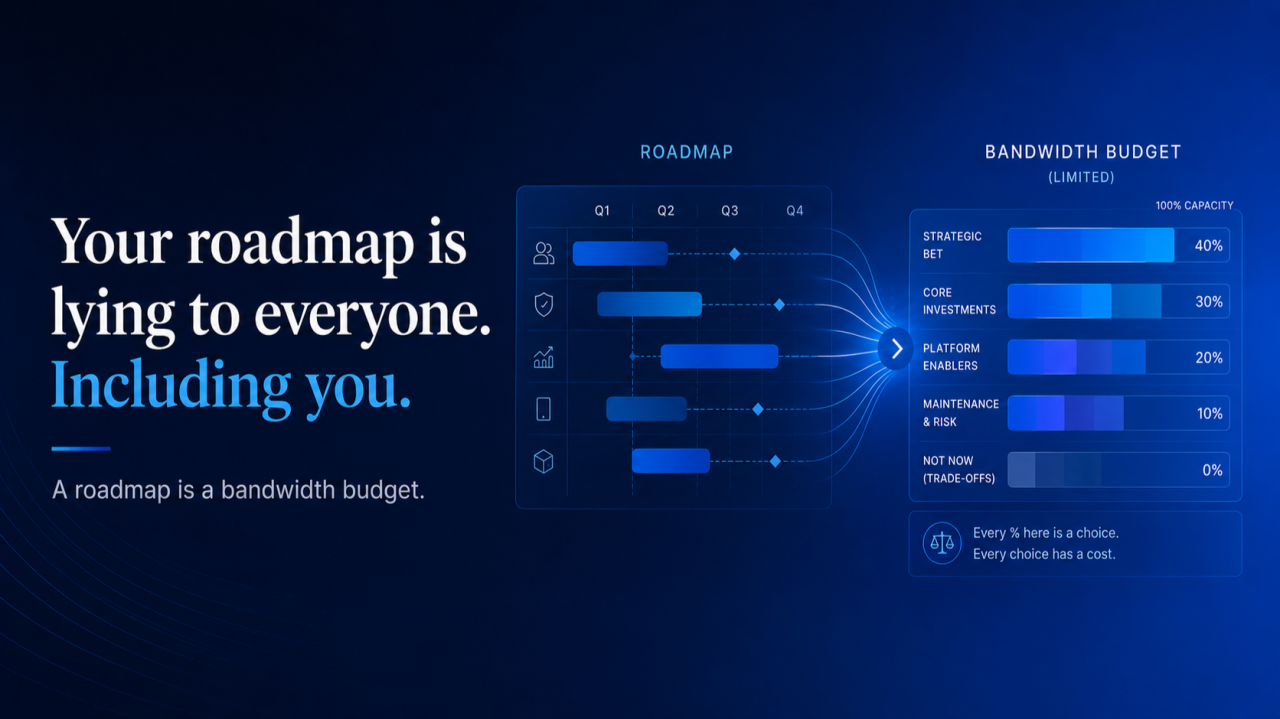
A roadmap is a bandwidth budget.
Your team has a fixed amount of capacity. Every hour spent on one problem is an hour not spent on another. The roadmap is just an answer to how you're distributing that capacity — and more importantly, what you're consciously choosing not to prioritize.
When you write a roadmap as vision, the trade-offs are invisible. Everyone reads hope into it. The customer sees their request somewhere on the timeline. The team sees the interesting problems. The investor sees scale. Nobody feels the constraint — because you never made the constraint explicit.
But when you write it as bandwidth allocation — this customer's needs get X% of our capacity, this governance work gets Y%, this new customer onboarding gets Z% — suddenly the trade-offs are on the table. And the conversations that follow are honest ones.
That shift is uncomfortable. Telling a customer "we're putting 20% of capacity toward your account this quarter, not 60%" is harder than "it's on the roadmap." But it's the only version that actually means something.
The problem: you can't allocate honestly what you can't see clearly.
Here's where it breaks down in practice.
Making a real bandwidth call requires holding a lot in view at once. What is each customer actually asking for, and why? What's the team's current load and where are the real blockers? What competitive pressure makes certain bets more urgent than they appeared last month? What have you already committed to, and to whom?
Most CPOs making these calls are working with scattered, incomplete context. Customer needs live in CRM notes and email threads. Delivery status lives in project trackers. Competitive signals live in someone's slide deck from last quarter. Financial signals live in a spreadsheet that arrives on Fridays.
None of it connects. None of it is organized for the moment of decision.
So what happens? You allocate bandwidth to whoever showed up to the meeting. To the customer who escalated loudest. To the feature that's easiest to explain. Not to what the full picture actually says.
What changed for me: building a CPO wiki.
I started building a personal knowledge system — a CPO Intelligence Wiki — where every source that informs product decisions gets ingested, synthesized, and cross-linked into a single organized structure: customer conversations, competitive signals, delivery status, team capacity, financial data. Maintained by AI. Owned by me.
I wrote about the in-meeting version of this in an earlier piece — how it changes real-time decision speed. But the deeper change has been in the roadmap itself.
Now when I sit down to make a bandwidth call, I'm not reconstructing context from memory. I can see account health across every customer, what's in flight and what's blocked, the competitive signal that makes one bet more urgent than it appeared, and what I committed to, when, and why.
The decisions aren't always easier. But they're honest.
Recently I made a call to put an anchor customer on reduced bandwidth — not because their account wasn't important, but because across the full picture I could see that what would actually protect their account long-term required fixing something structural first. That's not a call I could have defended confidently without organized context. With it, I could explain exactly why — to my team, and to them.
The roadmap is only as honest as the information behind it.
Most product leaders spend more time formatting their roadmap than organizing the intelligence that should inform it. I used to be one of them.
The roadmap that makes everyone happy is usually the one doing the least work. The one that reflects real bandwidth decisions — including the uncomfortable ones — is the one that actually guides execution.
You can't get there by thinking harder. You get there by answering the question most roadmaps avoid: whose problem are we choosing not to solve this quarter?
Originally published on LinkedIn. View the original →